|
Gallery No 39 - Troopships
|
|
Images of 112,000 ships - there are 150 Images of Troopships relating
to 1925/1965 shown in the first section listed below, with another
51 Empire troopships which can be accessed in the EMPIRE
section.
Aba - Asturia 1 & 2 - Almanzora - Andes 1
& 2 - Aragon - Aquitania - Britannic - RMS Cameronia - SS Canberra
- Cheshire - Derwent - Devonshire - Dilwara - Dominion Monarch - Dorsetshire
- Dunera - Dunottar Castle - Durban Castle - Empire Brent - Empire
Bure - Empire Call - Empire Clyde - Empire Dynasty - Empire Fowey
- Empire Halladale - Empire Helford - Empire Ken - Empire Medway -
Empire Orwell - Empire Parkeston - Empire Pride - Empire Star - Empire
Test - Empire Trooper - Empire Wansbeck - Empress of Australia - Empress
of Britain - Empress of Japan/Empress of Scotland - Ettrick - Euripides
- Franconia - Georgic - Highland Monarch - Highland Princess - Highland
Chieftain - SS Inervia - Imperator - Ile De France - Laconia - Lancastria
- Lancashire - Laurentic - Leonardo De Vinc - (Empire Clyde 1) - Llangibby
Castle - Majola - Mooltan - Nevasa 2 & 3 - New Australia - Neuralia
- Ormode - Orbita - Orontes, - Oxfordshire - Otranto - Orduna - Oransay
- Orion - Osmaneih - - QE2 - Queen of Bermuda - RMS Queen Elizabeth
- RMS Queen Mary - Rajula - Rewa - Rhona - Saga - Somersetshire -
Tairea - Talamba - Taliwa - Talma - SS Transylvania - Vienna - Warwick
Castle - Windrush - Winchester Castle - Windsor Castle - Worcestershire
- Zaria
If you are an ex-serviceman and also an oldie you will probably
have travelled overseas in a troopship. So scroll down these images
and find your "cruise ship".
These images have been made available to this website by Bryan Tab
Hunter, Roy Nixon, Hector, Mike Smith, Harry Furr, Karlz Glover, Jim
MacDonald, Leslie Youdell, Phil Booth, David Armstrong and Ian Girvan.
Extra information from Derek Lovemore, Ron Flood, Chris Madden, Graham
Hibbert, Roy Haskett, Terry Fitzpatrick, Stanley Embling, Ernie Huntley,
James Ignis, B J Jayne, Ian White, Peter Smith, Ex L/cpl K.Phillips
Royal Signals, John Parsons (RN retired), Sib Browne , Janet Martin,
John Dougherty .
Encyclopædia Britannica, Inc. - Cunard Shipping Line - www.liverpoolships.org
For which I extend grateful thanks.
Memory of - Ernest Graham Rutherford
The Army
Children Archive (TACA) - This Link will interest former and current
army children who will have travelled the world, who, on the one hand,
may find that it ignites some sparks of recognition that in turn trigger
a string of memories or, on the other, may enjoy the sense of having
a rich history all of their own.
The World War II 'Empire' ships covers a wide range of vessels,
ranging from tugs, coasters, tankers and cargo ships to passenger
liners, both wartime built and requisitioned, and post war reparations
ships. Also included are a few ships which were renamed 'Empire' at
the time of the Suez crisis.
This directory lists each ship, together with previous and subsequent
names and owners and is purely a guide to subsequent research. Managers
while under Ministry of War Transport ownership are also given, where
known.
Any information on errors or additional information on ultimate dispositions
of ships, or on managers while under MOWT ownership, where this is
not given, will be gratefully received and should be sent to -
mariners-L@efinch90.fsnet.co.uk
In the days before air travel, the British Armed Forces travelled
by sea to all corners of the Empire. The Ministry of Transport gave
contracts with civilian shipping lines to build and manage troopships
and often made financial contributions to their construction.
After the World War Two, many German and Italian commercial vessels
were seized and distributed to British companies as war prizes. EMPIRE
section.
(Be patient with loading)
|
|
ABA / GLENAPP / MATRONA 1918
The ABA was a 7,937 gross ton passenger ship,
450ft x 55.8ft, twin screw motor ship, speed 14 knots, accommodation
for 225-1st, 70-2nd and 70-3rd class passengers. Laid down
in 1916 by Barclay, Curle & Co., Glasgow for the Imperial
Russian Government, work was suspended when the October Revolution
occurred and she was taken over by the Shipping Controller.
Completed Sep.1918 as a funnelless, four masted cargo ship
and named GLENAPP for the Glen Line (McGregor, Gow & Holland).
1920 purchased by the British & African Steam Nav. Co.
(Elder Dempster & Co.), she was rebuilt with one funnel,
fitted with passenger accommodation and renamed ABA. In Nov.1921
she commenced Liverpool - West Africa sailings.
Dec.1929 damaged in heavy weather off Kinsale
and towed to Queenstown after her steering gear failed. Jun.1931
grounded at Lagos but refloated and Nov.1931 laid up at Dartmouth.
Apr.1933 back in service for Elder Lines Ltd and in Sep.1939
was requisitioned by the Admiralty and converted to a Naval
Hospital Ship. Mar.1940 transferred to the Army and took part
in the evacuation from Norway and was then transferred to
Alexandria. May 1941 bombed and damaged off Crete and then
used variously on Eastern Mediterranean and Middle East -
South Africa services. Mar.1944 clearly marked as a hospital
ship, she was again bombed at Naples.
After repair, she was used on the North Atlantic
and after D-Day was used on the Southampton - Cherbourg service.
Decommissioned in Jan.1947 and returned to Elder Dempster
& Co., she was too old to be worth reconditioning and
was sold to Bawtry SS Co., Liverpool and renamed MATRONA for
conversion to an emigrant carrier. However, when her ballast
was removed, she fell onto her side in Bidston Dock Eventually
righted in Jun.1948 by seven locomotives on specially built
tracks, she was towed to Barrow-In-Furness where she was scrapped.
[Merchant Fleets, vol.20 by Duncan Haws]
|
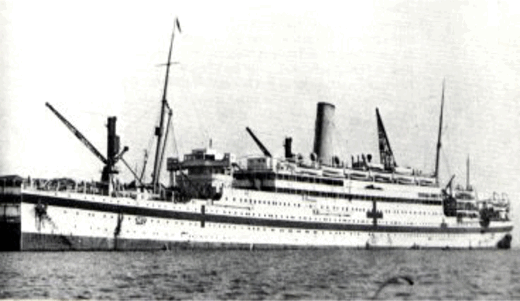
MV Asturias (1)
In role as Hospital Ship - Prior to being sold to Japan after
WW1 |
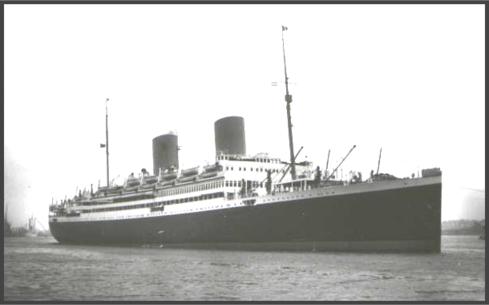
HMT. Asturias (2)
|
HMT.
Asturias (2)
Built: 1926 by Harland & Wolff, Belfast - When she was
launched she was the largest motor ship in the world and also
the first Royal Mail passenger ship which had a cruiser stern,
her forward funnel was a dummy. She made her maiden voyage on
the South American service with Commodore E.W.E. Morrison in
command, at the time it was reported that not only was the ship
slow but that she suffered from severe vibration as well. Due
to the aforementioned irresolvable problems she was re-engined
with two Parsons Single Reduction Geared Turbines, her bow was
reshaped and she was fitted with new propellers. This increased
her horsepower to 20, 000 SHP and for aesthetic purposes as
well as soot the height of her funnels was increased. She was
Royal Mail's representative at the Silver Jubilee Spithead Review
in 1935 for George V and Queen Mary.
At the outbreak of hostilities she was converted to an Armed
Merchant Cruiser for use on the South Atlantic patrols, her
fore funnel and mainmast were removed to improve the capabilities
of her anti-aircraft guns. In July of 1943 she was torpedoed
in the South Atlantic but was successfully towed to Freetown
some five hundred miles by Zwarte Zee. With her Engine Room
flooded she lay there for two years and was finally abandoned
by Royal Mail. In 1945 she went undertow again by Zwarte Zee
with an escort of seven Corvettes she made her way to Gibraltar
for temporary repairs before being towed to Belfast for an extensive
refit. She became a Government Emigrant ship and in 1953 repatriated
British troops from Korea. She underwent further refurbishment
in 1954 and emerged in full trooping colours. In 1957 she was
sold for breaking but before she sailed on her final voyage
played the part of Titanic in the film 'A Night to Remember'
at Faslane.

At the outbreak of WW2 she was converted to
an Armed Merchant Cruiser for use on the South Atlantic patrols,
her fore funnel and mainmast were removed to improve the capabilities
of her anti-aircraft guns. In July of 1943 she was torpedoed
in the South Atlantic but was successfully towed to Freetown
some five hundred miles by the tug Zwarte Zee. With her Engine
Room flooded she lay there for two years and was finally abandoned
by Royal Mail.
In 1945 again under tow by Zwarte Zee with an escort of seven
Corvettes she made her way to Gibraltar for temporary repairs
before being towed to Belfast for an extensive refit.
She then became a Government Emigrant ship and departed Southampton
12-10-1946 for Sydney on her first run for the Australian Migrant
Service.
She continued on this Service without a break until arrival
at Southampton 30-10-1952 after her final return from Sydney.
On these homeward journeys she carried Australian troops who
disembarked for duty at Malta or other ports en route.
In 1952 she was commissioned as a British troopship and on her
first voyage departed Southampton on 20 Nov 1952 - carrying
Australian Naval Personnel. A number of these passengers are
visible on the forward open deck in the
photo taken (by Terry Fitzpatrick) as HMT Asturias arrived at
Singapore 11 Dec 1952.
Following this first run to Hong Kong the ship continued trooping
from UK to the Far East (including repatriation of British troops
from Korea and Japan) until her last return to Southampton 27
Aug 1957. She was released from Sea Transport service 12 Sept
1957 and played the part of Titanic in 'A Night to Remember'
filmed at Faslane before being sold for scrapping. |
SS. Almanzora

|
SS. Almanzora
Built 1915 - 1915-1919 Armed Merchant Cruiser, 1939-1945
troopship, 1945-1947 Government emigration ship, 1948 scrapped.
16,034
Memory of - Ernest Graham Rutherford
National Service number 1908762 Ernest Graham Rutherford
DOB 6th April 1923 (now living at 13 Walton place, Chesterton,
Newcastle, Staffs, ST5 4QY) - Was transferred from KOYLI in
1947 to DLI
1947 Set sail from Southampton in the June on SS Almanzora
, an old troupe ship had hammocks in), destination to Port
Said Egypt to Suez Canal (10day) in transit camp then moved
to bottom of Suez Canal. Then on train to top of Suez awaiting
for ship to Thessaloniki Greece, stayed there till 1948 transferred
back on SS Sithier(??spelling) arrived back Liverpool and
de-mobbed at York. April/May 1948.
Submitted by: Mrs K Chatterton (daughter of Mr Rutherford)
|
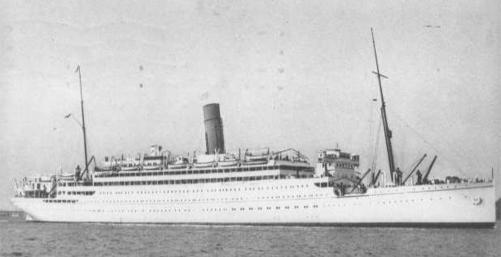
Andes (1)
|
Andes (1) - RMSP Atlantis - Andes
(1) (1913-1929 - 15,620gt)
Atlantis (1929-1952)
1913 1915-1919 Armed Merchant Cruiser, 1929
renamed Atlantis cruise ship,
1939-1946 Hospital Ship, 1948-1952 Australia
/ NZ emigrant ship, 1952 scrapped. 15,620 tons
RMSP Atlantis, built by Harland & Wolff
for the Royal Mail Line in 1913 and served as an hospital ship
in WW1
Converted to a hospital ship in 1939, she was
initially based at Alexandria, used in the Norwegian evacuation
in 1940 and then sent to the Indian Ocean for the next two years.
She took part in the Madagascar campaign in
1942 and in 1943 repatriated Italian prisoners of war to Lisbon
and Germans to Gothenburg. She continued hospital and repatriation
duties until 1946, was reconditioned to carry
900-3rd class passengers and used to carry
emigrants from the UK to Australia and New Zealand.
Laid up in 1952, she was scrapped the same
year. [Merchant Fleets by Duncan Haws, vol.5, Royal Mail Line]
|
|
|
RMV. Andes 2
Operating life: 1939 - 1971 - Tonnage: 25,689
- Passengers: 607
Constructed: Harland & Wolff, BelfastAndes was launced
6 months before the outbreak of World War Two. She was immediately
requisitioned as a troop carrier and spent the war on active
duty. In 1947 she was released back to the Royal Mail Line
and, after a major refit in Belfast, she commenced her commercial
service on routes to South America. In 1959 she was refitted
for cruising. In 1971 she made her last voyage to the breakers
in Belgium.
|
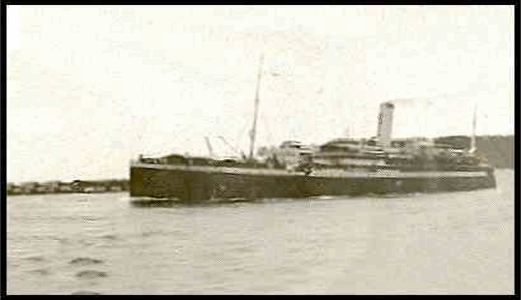
SS. Aragon
|
SS. Aragon
Leaving Durban Harbour 1917 Aragon (1) 1905
1917 torpedoed and sunk off Alexandria while
trooping; loss of 610 lives. 9,588tons.
|
RMS Aquitania
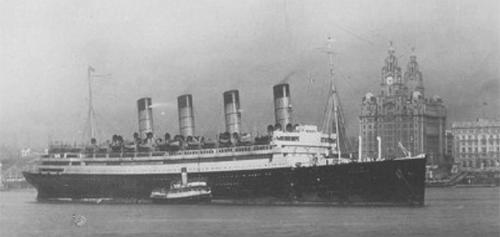
RMS Aquitania in The Mersey at Liverpool
Owner: Cunard Line - Liverpool, England - Builder: John
Brown & Co. Ltd. Clydebank, Scotland
Year Built: 1914 - Scrapped at Faslane, Scotland 1950. Dimensions
and machinery
Length: 901ft Engines: 4 Parsons direct drive steam turbines
by John Brown Beam: 97'
Tons: 45,647 tons
Lusitania and Mauretania are sometimes viewed as sister
ships but these were much
smaller in size and tonnage. Aquitania was designed by Leonard
Peskett, the designer of the Mauretania, and was based on
the Mauretania design.
Over 100,000 people attended the launch ceremony. During World
War 1 Aquitania transported over 25,000 wounded.
In World War 2 Aquitania sailed over 500,000 miles transporting
over 400,000 people. The only liner to serve in both world
wars. Sailed a total of over 3,000,000 miles during her career
carrying over 1.2 million
passengers.
Made 443 transatlantic voyages.
The last liner with four funnels in service.
(The Arundel Castle was the last of the four funnel liners
in service but, two funnels had been removed in 1937.)
|
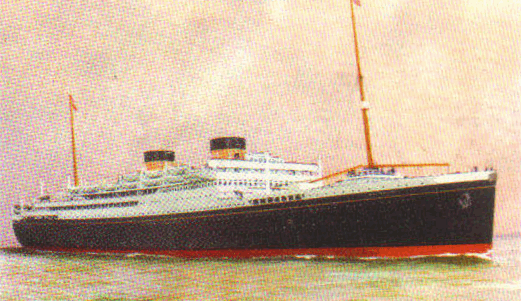
MV. Britannic
|
MV. Britannic ( Leslie W. Youdell)
The Britannic (3) - 1930 to 1960 Specifications:
Length: 712 feet (217.5 m)
Beam: 82 feet (25 m)
Tonnage: 26,943 gross tons
Engines: Burmeister & Wein diesels powering two propellers.
Service speed: 18 knots
Passengers: 1,553 people
|
For a lot more information on this ship: Click
here

First page of Passenger List (Karlz Glover)

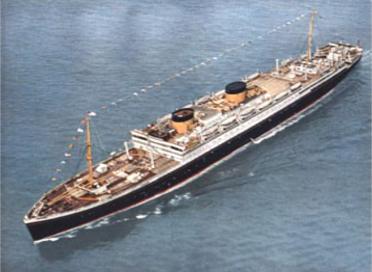
A lovely colour aerial photograph of the third Britannic.
(Picture courtesy of Kevin R. Tam)
MV. Britannic
|
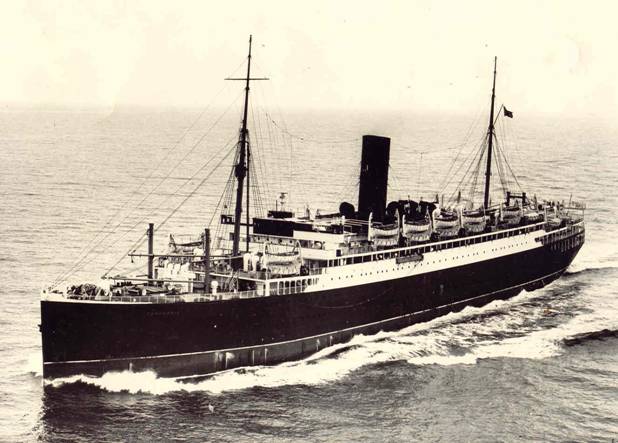
RMS Cameronia (1921
|
RMS Cameronia (1921)
Built by William Beardmore & Company, Limited in Glasglow
Scotland in 1921, Cameronia was 578 feet long and 70 feet
wide, displacing 16,280 gross tons. She was powered by steam
turbines geared to twin screws for a service speed of 16 knots.
Passenger capacity was 1,785 (265 First Class, 370 Second
Class and 1,150 Third Class).
Cameronia was built for the Anchor Line (British Flag) and
sailed the Glasgow – New York route. She was requisitioned
as a troopship in 1940 and used as such until 1947. She was
then rebuilt as an Australian immigration ship for the British
Ministry of Transport and put to sea in 1948. In 1953 she
was renamed Empire Clyde. She was decomissioned in 1956 and
broken up in Wales in 1957.
|
SS Canberra

|
|
SS Canberra
SS Canberra was an ocean liner, which later operated on
cruises, in the P&O fleet from 1961 to 1997. She was built
at the Harland and Wolff shipyard in Belfast, Northern Ireland
and was launched on March 16, 1960. The ship was named after
the federal capital of Australia, Canberra, and entered service
in May 1961.
Tonnage: 1961: 45,270 gross tons
1962: 45,733
1968: 44,807
1994: 49,073
Length: 249.9 m (818 ft)
Beam: 31.2 m (102 ft)
Draft: 9.97 m (32.7 ft)
Height: 55.9 m (183.5 ft) keel to funnel
Power: 85,000 horsepower
Propulsion: Two British Thompson Houston (AEI) synchronous
three-phase, 6,000 volt air-cooled electric motors; power
supplied by two 32,200 kW steam turbine driven alternators;
twin screw
Auxiliary Power: Four auxiliary steam turbines, each driving
a 1,500 kW, 440 V, 3 Phase, 60 Hz alternator and a tandem
driven 300 kW exciter for the propulsion alternators
Speed: Trials: 29.27 knots (54.3 km/h)
1961-1973: 27.5 knots (51 km/h)
1973-1997: 23.50 knots (43.5 km/h)
Complement: 1961-1973: 548 First class, 1,690 Tourist class,
960 officers and crew
1973-1997: 1,737 passengers, 795 officers and crew
Cost: UK £15 million
After the Argentine invasion of the Falkland Islands in
1982, which initiated the Falklands War, the Ministry of Defence
requisitioned the Canberra as use as a troopship. Nicknamed
the Great White Whale, the Canberra proved vital in transporting
the Parachute Regiment and Royal Marines to the islands more
than 9,000 miles (14,000 km) from the UK. Whilst Queen Elizabeth
2 was held to be too vulnerable to enter the war zone, Canberra
was sent to the heart of the conflict.
Canberra anchored in San Carlos Water on [[May 21]] as part
of the landings by British forces to retake the islands. Although
her size and white colour made her an unmissable target for
the Argentine Air Force, the Canberra, if sunk, would not
have been completely submerged in the shallow waters at San
Carlos. However, the liner was not badly hit during the landings
as the Argentine pilots tended to attack the Royal Navy frigates
and destroyers instead of the supply and troop ships. After
the war, Argentine pilots claimed they were told not to hit
the Canberra.
When the war ended, Canberra was used to repatriate the
Argentine Army, before returning to Southampton to a rapturous
welcome. After a lengthy refit, Canberra returned to civilian
service as a cruise ship. Her role in the Falklands War made
her very popular with the British public, and ticket sales
after her return were elevated for many years as a result.
Age and high running costs eventually caught up with her though,
as she had much higher fuel consumption than most modern cruise
ships. She was withdrawn from service in September 1997 and
sold for scrapping, leaving for Gadani Beach, Pakistan the
next month. She did not give up without a fight however; her
deep draft meant that she could not be beached as far as most
ships, and due to her solid construction the scrapping process
took nearly a year instead of the estimated three months.
|
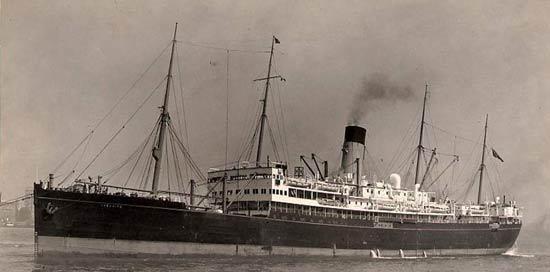
Cheshire
|
|
Cheshire (F 18) - Type: Armed merchant cruiser - Tonnage:
10.552 tons
Completed: 1927 - Fairfield Shipbuilding & Engineering
Co Ltd, Glasgow
Owner: The Admiralty , Homeport: Liverpool , Date of attack:
18 Aug, 1942 Nationality: British
History: On 29 Aug, 1939, the motor passenger ship Cheshire
from Bibby Brothers & Co, Liverpool was requisitioned
by the Royal Navy as armed merchant cruiser and became HMS
Cheshire (F 18)
At 21.28 hours on 14 Oct, 1940, the HMS Cheshire (F 18) was
struck by one torpedo from U-137 (Wohlfarth) northwest of
Ireland (Grid AM 4561). She reached Liverpool but had to be
laid up for repairs for six months.
On 9 Jun, 1943 the ship was returned to the owner and then
used by the Ministry of War Transport (MoWT) as troop transport.
Used as repatriation ship in 1945 and on 5 Oct, 1948 finally
returned to the owner.
|
Derwent
|
SS Derwent (3) 1949
Ex- Persic, 1969 transferred from Shaw Savill
& Albion Line renamed Derwent, scrapped 1971. 13,594tons
|
Devonshire
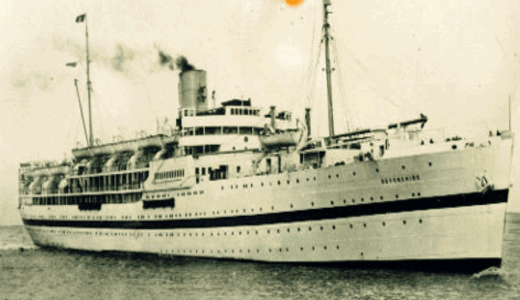
Devonshire
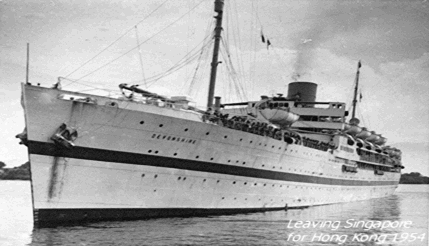
Leaving Singapore for Hong Kong 1954
|
MV. Devonshire
Operating life: 1939 - 1967 - Tonnage: 11,275
- Passengers: 1,344
Constructed: Fairfield, Glasgow
Devonshire was delivered to the Bibby Line just before the
outbreak of World War Two. After her war service she continued
trooping until her sale in 1962 to the British India Line.
She was then refitted as an educational cruise ship and renamed
the Devonia. She was scrapped in 1967.
|
Dilwara
|
SS. Dilwara - Launched 1935:
--------------------------------------------------------------------------------
built by Barclay Curle & Company Glasgow,
Yard No 654
Engines by Barclay Curle & Co Glasgow/ Doxford
--------------------------------------------------------------------------------
Last Name: KUALA LUMPUR Port of Registry: Hong Kong Propulsion:
2 x Diesel
Launched: Thursday, 17 October 1935
Built: 1936 Ship Type: TroopShip
Tonnage: 12598 grt | 7512 nrt | 3435 dwt Length: 517 feet
Breadth: 65 feet Draught: 25 feet
Owner History: British India Steam Nav Co - China Nav Co Hong
Kong
Status: Arrived for Scrapping - 01/12/1971
|
Dominio Monarch
|
SS. Dominion Monarch in 1939
One of Shaw Savill Line's principal ships for many years
was Dominion Monarch, which lived up to her regal status by
having only first- class accommodation for 523 passengers.Built
by Swan Hunters in the late 1930s, the 26,500-ton liner was
designed for a new service from Southampton to South Africa,
New Zealand and Australia.Dominion Monarch had the distinction
of being the last really big British motor liner. A quadruple-screw
vessel 650ft long, with an 85ft beam, she set a new fashion
by having a single mast set well forward, while her two funnels
were aft of midships.The ship had only just begun her career
when the Second World War broke out and she was taken over
for troopship duties. When peace returned Dominion Monarch
was welcomed back to Southampton when she brought in valuable
food from New Zealand.By the 1960s Shaw Savill, worried about
rising fuel costs, decided to have her broken up.The last
commercial voyage started from Southampton on December 30,
1961, returning the following April when all the ships in
port saluted her on their whistles.
|
Dorsetshire

|
TSMV Dorsetshire
Built Belfast Harland and Wolff 1920 450 feet long, 57.0
feet wide, 34.4 draft, 2-6 cyl 4SC SA
Burmeinster and Wain diesel engine, 7,450 tons, but 9,345
tons as trooper. Cargo liner from 1920 -1927, Trooper from
1927. Hospital ship WWII Trooper post war,. Migrant service.
1952 hostel, Little Aden Oil refinery. BROKEN UP 1954
-------------------------------------------
I have just seen your web site and saw a picture of the
old HMT Dorsetshire, in which I sailed to Egypt in in April
1938. I have a postcard of her with some specifics about her
which might be of interest to you.
Printed below the photo (picture) are the following ponts:
9,647 tons Length 466ft. Breadth 57ft Speed 12 knots
I recall vividly my surprise to find the `Bay' very smooth,
however a few hours after dropping a few members at Gibraltar,
we ran into a very bad storm and we seemed to have lost the
use of a `Screw' so had to return to Gib. in order to correct
the situation. That storm resulted in more than 95% being
Seasick. A far from pleasant experience, especially on a Troopship.
However I also recall acting as a steward in our (RCofS) Sgt's.
Mess and having to collect and hang the Hammocks for them
before collecting my own. But what a wonderful experience
awaited me when actually sleeping in a Hammock.
Strange how memories are recalled after so long and now at
the age of 88 I am completing my memoires as far as possible
and at the end I have a picture gallery including the picture
of the old Dorsetshire..
Now a Canadian Citizen and belonging to several `Old Comrades
Groups' I still wear uniform at special functions. - Ernie
Huntley
|
Dunera
|
Dunera in 1937
The 12,615-ton Dunera made her maiden voyage from Southampton
to China in September 1937.She was closely associated with
the port, first as a troopship for 24 years and then as a
pioneering educational cruise liner for seven years.
The ship was ordered by the British India Steam
Navigation Company from the Barclay Curle shipyard in Glasgow
and when completed was chartered by the government to carry
troops.She and her sister ship, Dilwara, represented considerable
advance on the older troopships. During the Second World War
the ships took part in the evacuation from Singapore and landings
at Madagascar, Sicily and southern France.
Modernisation and refit work in 1950 at Glasgow
cost nearly £1m and Dunera continued in service until
trooping by sea finished. She still had plenty of life left
in her and British India embarked on a bold experiment.The
company decided she should continue in service as Britain's
first permanent schools cruise liner. During the first year
in her new role, she carried more than 10,000 youngsters.
Her achievements paved the way for the introduction
of other retired troopships into cruising operations.Sadly,
Dunera was finally broken up for scrap in Spain in 1967.
MEMORIES "SNIPPETS" OF A RAMC MEDICAL
ORDERLY, HMT DUNERA 1958
The send off from Southampton was always
a nostalgic occasion with military bands, flag waiving with
lots of tears from wive's and girl friends. Sailing down Southampton
Water for the first time I wondered if I would ever see England
again. little did I know than in 39 years I would be doing
this again on the liner Oriana.
Very few of the young men on board had been abroad before,
like me, for most overseas was crossing the Menia bridge to
Anglesey or the ferry to the Isle Of White. The bay of Biscay
was always rough; we gave out sick pills but I don't think
they were any good.
When ever we past another troop ship (it would be announced
on the ships tannoy) there was always lots of waving and if
the other ship was homeward bound shouting of "You lucky
Bas-----ds", (not that they could hear.")
Everyone knew about the sinking of the Windrush so life hboat
drill was actually taken seriously, Gibraltar was always the
first port of call (or the last), outward bound no shore leave
was permitted to prevent troops going AWOL and disappearing
across the border into Spain.
The weekly FFI (free from infection) inspections were an undignified
procedure with personnel lined up in four rows in PT shorts,
the shorts would be dropped while we inspected hair and pubic
hair, the penis and other areas. If anything abnormal was
found or suspected the poor initial would be refered to the
MO, officers were examined by the MO and women QA.'s.
The MOD issue French letters (now called condoms) were the
thickness of bicycle innertubes and inverably thrown away"
|
Dunnottar Castle
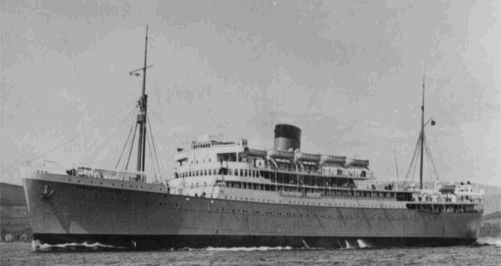
|
Dunnottar Castle
15,000tons - Princesa Victoria was built in 1936 by Harland
& Wolff, Belfast, for Union-Castle Line as the Dunnottar
Castle. She was used on the London (Tilbury) - round Africa
service until the outbreak of WW2, when she was converted
to an armed merchant cruiser, and then later used a troop
transport. In 1949 she resumed her London - round Africa service.
In 1958, Dunnottar Castle was sold to Incres SS Co, who renamed
her as Victoria and substantially rebuilt her in Rotterdam.
Victoria entered service in 1960 on New York-West Indies cruises.
In 1964, Victoria was sold to Victoria SS Co, a subsidiary
of the Swedish company Clipper A/B, but retained her name,
service and Incres Line as her agents.
Victoria was bought by Chandris in 1975, resuming sailings
as The Victoria in June 1976. She cruised in Europe and the
Caribbean until 1993, when she was sold to Louis Cruise Lines
who used her on cruises from Cyprus as Princesa Victoria.
She was then the oldest large cruise ship (over 10000grt)
then still in passenger service. She was sold for breaking
up in 2004.

Dunnottar Castle
Another view, it is from a postcard mailed in March 1958
at which time it had reverted to commercial service to East
Africa. (Supplied by Ian White.)
|
|
Durban Castle
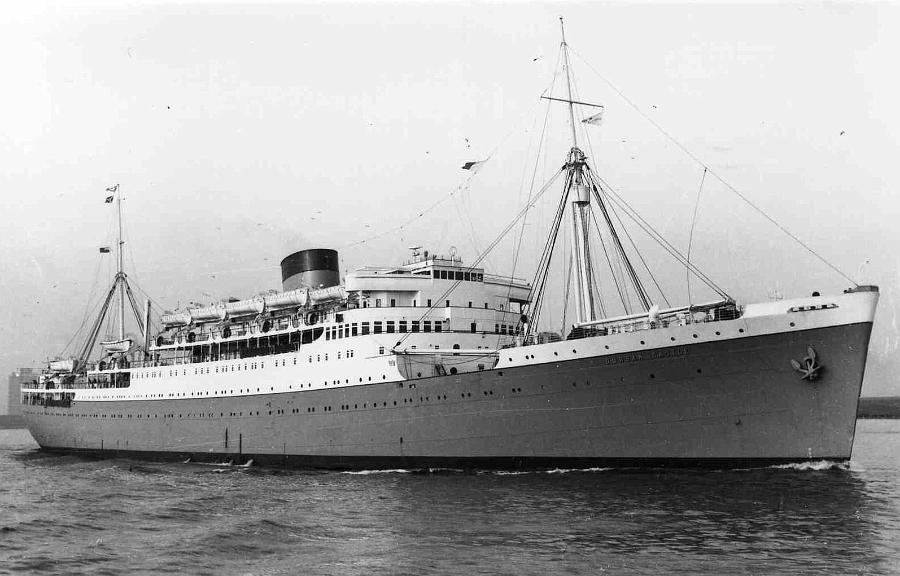
Durban Castle

|
Durban Castle
DURBAN CASTLE was built in 1938 by Harland & Wolff at
Belfast with a tonnage of 17382grt, a length of 594ft 7in,
a beam of 76ft 4in and a service speed of 18.5 knots.
She was Built for the Round Africa service and inaugurated
the practice of naming ships after non-existent South African
castles.
In September 1939 she was converted into a troopship. When
Greece fell in 1941 the King of Greece and his family first
took refuge in Egypt and then South Africa from where the
Durban Castle transported him, his family and entourage from
Durban to the United Kingdom.
In 1942 she was converted into a Landing Ship Infantry with
nine landing craft on each side and on 6th November took part
in the North African landings at Arzue. During July 1943 she
landed the 41st Marine Commando on Sicily and later landed
troops at Salerno and Anzio. On 15th August 1944 she landed
troops near Cannes during the invasion of southern France.
She returned to commercial service in 1946 still carrying
her AA gun platforms and with 9 lifeboats on each side replacing
the landing craft.
This austere situation was rectified when she was later
re-furbished. In July 1947 she resumed service, initially
on the mail service pending the return of the larger ships
which were themselves being refurbished after war service,
and then on the Round Africa service.
On 28th March 1962 she completed her final voyage in London
and in the following month was sold to Eisen & Metall
GmbH of Hamburg for breaking up.
|
Empire Brent
|
Empire Brent/Cook
Letitia (2) (1925-46)
Empire Brent (1946-51)
Captain Cook (1951-60)
In the early twenties, Fairfield Shipbuilding and Engineering
Co Ltd of Glasgow built two very similar sister ships for
the Donaldson Line. One was called ATHENIA, and was to achieve
a certain kind of fame by being torpedoed and sunk by U30
on September 3rd 1939, the first passenger liner to be sunk
in the war. She second ship was to have a varied and much
longer career and was named LETITIA.
She was launched on October 14th 1924 and completed in April
1925. She grossed 13,475 tons, was 538' long overall, and
had a beam of 66.3'. Geared turbines drove the ship through
twin screws at a speed between 14 and 16 knots and she was
built to burn either coal or oil. Her crew numbered 300 and
she could carry 516 Cabin Class passengers with 1,023 in Third
Class. She began her maiden voyage on April 25th 1925 and
thus introduced herself to the Glasgow-Montreal service on
which she was to run until 1939. In 1933 she was given a refit
in which her passenger accommodation was modified to take
298 in Cabin Class, 310 in Tourist, and 964 in Third.
At the start of World War Two, LETITIA was converted first
to an AMC and later to a troopship. Her role changed again
in 1944 when she was taken over by the Canadian Government
for conversion to a hospital ship. She survived in this role
until the end of the war when she was bought by the British
Ministry of Transport. She remained under Donaldson management
but was renamed EMPIRE BRENT. On November 20th 1946 she was
involved in a collision with the British steamer STORMONT
which sank.
A refit on the Clyde between December 1947 and mid-1948
prepared EMPIRE BRENT for her post-war employment and she
began her first trooping voyage to the Far East in July 1948.
By 1950 she was being run outward bound to Australia with
emigrants and being used as a troopship on homeward journeys
as required. During this period of her life the ship might
best have been described as an "associated unit"
of the peacetime trooping fleet. In June 1951 she began yet
another refit, which was to last until January 1952, to convert
her fully to an emigrant carrier. Her gross tonnage was increased
to 13,876 tons and she was able now to carry 1,088 passengers
in one class. She left Glasgow for New Zealand for the first
voyage after this refit on February 5th 1952.
The latest refit had been brought about by the ship having
been chartered to the New Zealand Government in 1951. She
was kept under Donaldson management but renamed CAPTAIN COOK
and ran from Glasgow to New Zealand via Panama. Still she
made the occasional voyage home from the Far East with British
military personnel. Between April and October 1955 her itinerary
was varied somewhat when she ran seven voyages from Glasgow
to Liverpool and Montreal for Donaldson, the route of her
maiden voyage thirty years earlier.
CAPTAIN COOK'S New Zealand charter expired in the summer
of 1959 and was not renewed. The vessel was old, and as no
further employment could be found for her, she was sent for
breaking by TW Ward at Inverkeithing where she arrived on
April 29th 1960.
|
Empire Bure

|
Empire Bure formerly the Charlton Star
Stanley Embling writes: I sailed on the troopship Empire
Bure to Jamaica in late February 1949 from Liverpool.... I
returned from Jamaica on the Empire Test I do believe in the
early part of 1953
Lineage of the ship see below.
Elizabethville/HMT. Empire Bure/Charlton Star ( Details
supplied by James Ignis)
History SS Charlton Star, Built by John Cockerill Shipyards,Hoeboken,Belgium
8178 Gross Tons, 439 Feet long
57 Feet wide Steam quadrepal expansion engines,twin screw
Service Speed 14 Knots
700 one class passengers
1921 Elizabethville, Cie Belge-Maritime Du Congo,Antwerp
1930 Cie. Maritime Belge,Antwerp
1940 MOWT Troopship, Managed by Lamport & Holt, Liverpool
1946 Cie Maritime Belge
1947 Empire Bure MOWT managed by Lamport & Holt Line,
Liverpool
1950 SS Charlton Star,Charlton SS Co London (CHANDRIS)
1958 Maristrella AJ & DJ Chandris, Liberia
1960 Scrapped at Osaka
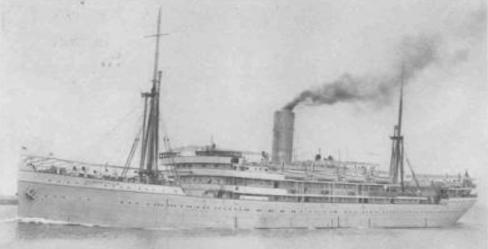
A very early picture of the Elizabethville
|
Empire Call

|
Empire Call (1944~1945) - SS Ingenieur General Haarbleicher
Name: Empire Call (1944-45)
Ingénieur Général Haarbleicher (1945)
Owner: Ministry of War Transport (1944-45)
Ministère de la Marine Merchande (1945)
Operator: Gibbs & Co Ltd (1944-45)
Compagnie Générale Transatlantique (1945)
Port of registry: United Kingdom Greenock (1944-45)
France Marseilles (1945)
Builder: William Hamilton & Co Ltd
Yard number: 462
Launched: 10 February 1944
Completed: July 1944
Out of service: 21 November 1945
Identification: United Kingdom Official Number 169509 (1944-45)
Code Letters GCWK (1944-45)
Code Letters FPPK (1945)
Fate: Ran aground 1945, scrapped in situ 1947.
General characteristics
Tonnage: 7,067 gross register tons (GRT)
4,759 NRT
Length: 433 ft 5 in (132.11 m)
Beam: 56 ft 2 in (17.12 m)
Depth: 34 ft 2 in (10.41 m)
Installed power: Triple expansion steam engine
Propulsion: Screw propellor
Empire Call
Empire Call was built for the MoWT. She was operated under
the management of Gibbs & Co Ltd. She was allocated the
United Kingdom Official Number 169509 and used the Code Letters
GCWK. Her port of registry was Greenock.
Empire Call was a member of a number of convoys during the
Second World War.
SC 159
Convoy SC 159 departed Halifax, Nova Scotia on 18 October
1944 and arrived at Liverpool on 2 November. Empire Call was
carrying a cargo of flour, destined for Cardiff.
ONS 97
Convoy ONS 97 departed Belfast Lough on 29 November 1944.
Empire Call was bound for New York.
The troopship 'Empire Call' which transported the 43 Wessex
Division to Normandy in 1944.
Mike Lewis
|
Empire Clyde
|
Empire Clyde/Cameronia
TSS. Cameronia - later renamed SS. Empire Clyde - 7515tons
built 1925 Passenger ship.
The first large British passenger liner laid down after the
1914-18 war was Anchor Line's CAMERONIA. She was one of a large
group of very similar looking vessels laid down at about the
same time which included, fir instance, Donaldson's LETITIA
and Cunard's TYRRHENIA. Beardmore and Company of Glasgow launched
her on December 23rd, 1919 after a construction period of only
nine and a half months and she was completed in March 1921.
As built, the ship grossed 16,280 tons, was 678' long overall,
and had a beam of 70.2'. Steam turbines and twin screws gave
her a service speed of 17 knots and her initial capacity was
for 265 passengers in first class, 370 in second, and 1150 in
third with a crew of 320. She began her maiden voyage on May
11th, 1921 and continued in the Liverpool to New York service
until she was laid up in the Clyde in December 1934 as a result
of the Depression. The only events of great note in her career
to this date were her collision with the small Norwegian steamer
HANK in the Clyde in 1925 and her Beardmore refit of 1928-29.
Some rebuilding forward was part of this refit and was designed
to counteract the ship's inclination to pitch heavily. By May
1929vthe work was completed and her passenger capacity had been
altered to 290 Cabin Class, 431 Tourist Class, and 698 Third.
In 1935 CAMEROMIA was taken over by the British government
for a few trooping voyages to the Middle and Far East after
which she was refitted and placed in the Glasgow-New York service
starting on July 10th 1936. The Coronation Fleet Review of 1937
provided another short spell of government employment when CAMERONIA
was hired by the Admiralty as a VIP grandstand.
The ship continued in unescorted commercial service to New
York for a short while after the start of World War Two. She
was, in fact, the first British vessel to enter New York after
the war had been declared. She left New York on what was to
be the last Anchor Line Atlantic passenger voyage on November
4th, 1940 and was taken over for conversion to a troopship on
arrival at Glasgow. Her conversion was rapid and she was ready
for trooping service in January 1941. During her war service
CAMERONIA was damaged by air attack in the Mediterranean. She
had to return to the Clyde for repairs after having been disabled
by aerial torpedo off Bongie on December 22nd, 1942. She was
the largest troopship to take part in the allied landings in
Normandy and was on the scene the day after the initial assaults.
In August 1944 she was present also at the landings in Southern
France.
At the end of the war CAMERONIA was laid up until she was
needed again by the government in the spring of 1947. This time
she was needed for trooping to Palestine which occupied her
until she was taken in hand by Barclay Curle and Company for
conversion into an emigrant ship in the Australian trade. Her
gross tonnage was increased to 16,584 tons and she was given
accommodation for 1,266 passengers in one class. She made her
first voyage as an emigrant carrier between Glasgow and Sydney,
leaving the UK on November 1st, 1948. She continued in this
trade until being bought by the Ministry of Transport in 1953
for conversion to a permanent troopship, possibly as a result
of increased trooping demand in connection with the Korean War.
Renamed EMPIRE CLYDE, she became a regular on the Far Eastern
trooping run. Her career as a peacetime trooper, however, was
not long, for as the need for such vessels declined she was
sold eventually for scrap, arriving at Newport, Monmouthshire
in early October 1957 for breaking by John Cashmore Ltd.
Memory by Derek Lovemore
My own experience was on the Empire Clyde in February 1954
outbound from Liverpool to Bermuda carrying the 1st Battalion
Duke of Cornwall's Light Infantry. The Irish Sea was at its
most turbulent for many years and the decks were literally awash
with vomit for many days, until the ship sailed well out into
the North Atlantic. How sweet the smell and scents of Bermuda
after 8 days.
Memory by L/Cpl K Phillips Royal Signalss
I was in a Royal Signals draft to the Middle East in August
1947. We went to Greenock and boarded the Camoronia,with some
ceremony, a band playing amongst other numbers,Goodbye Dolly
Grey. We were due to sail at 1200 hours but made no move.Sailing
was now 1800hours .No move, sailing now 0600on the following
day. Still no sailing.This continued until an hour or so after
1200 when the ship moved about 100yards from the dock.I think
the the crew decided it was enough as we returned to the dock
and after two more days aboard we returned to our depots.In
late August I eventually sailed for the ME on troopship Cheshire
from Liverpool. Both of these troopers were old style ships
with hammocks slung over mess tables.There were about 650 troops
on each troopdeck.
|
Empire Dynasty
|
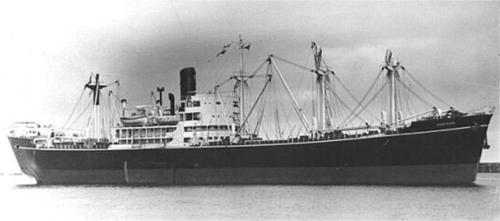
Empire Dynasty - Eastern - Dori.
EmpireDynasty 9905gross tons, 475length, 64beam, 24draft,
built1944 MOWT managed by Lamport & Holt Line.
1946 EASTERN, Eastern & Australian SS Co, London.
1964 DORI, Eddie SS Co, Taiwan.
1969 Scrapped Taiwan.
|
Empire Fowey
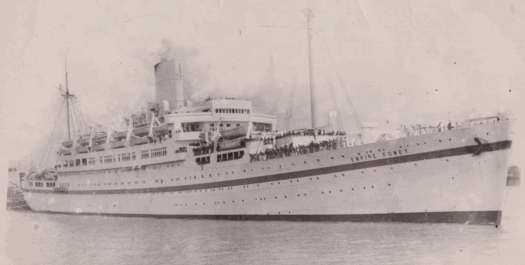
Empire Fowey (Supplied by Mike Smith)

|
Empire Fowey
Copy of a card sent by my father to his mother. It is not
dated, but the back states “It is a lovely ship and
is on the maiden voyage after being refitted at some tremendous
cost” I think it must have been sailing to Kenya during
the Mau Mau troubles when my father was serving with the Buffs.
Christopher Excell.
Operating life: 1935 - 1976
Tonnage: 17,528 - Passengers: 286 - Constructed: Blohm &
Voss, Hamburg
Empire Fowey was originally called the Potsdam and was seized
by the Allies in Flensburg in 1945. She sailed for one year
as the Empire Jewel before taking the name of Empire Fowey
in 1946 under the management of P&O. In 1960 she was sold
to Pakistan and became the Safina-e-Hujjaj. She was scrapped
in Karachi in 1976.
|
Empire Halladale
|
HMT. Empire Halladale - Operating life: 1922 - 1956
Tonnage: 13,589 - Passengers: 1,886 - Constructed: Vulcan,
Hamburg The Empire Halladale was formerly known as the Antonio
Delfino. She was built for the Hamburg South American Line
and sailed on the Hamburg to River Plate route until 1932.
During the war she performed various duties and was captured
together with Pretoria in Copenhagen in May 1945. She trooped
under the management of the Anchor Line until her break-up
in 1956.
|
Empire Helford
|
Empire Helford
In 1946 to 1950 this was Empire Helford
Built 1915 - 6598tons 440length 53beam 1Passenger Ship.
1915 CZARITZA, Russian American Line.
1917 The Shipping controller managed by Ellerman's Wilson
Line.
1917 The Shipping controller managed by Cunard SS Co.
1920 LITUANIA, Baltic American Line.
1930 KOSCIUSZKO, Gdynia America Line, Poland.
1939 GDYNIA, Polish Navy.
1945 KOSCIUSZKO, Polish Navy.
1946 EMPIRE HELFORD, MOWT managed by Lamport & Holt Line,
Liverpool.
1950 Scrapped Blyth
|
Empire Ken
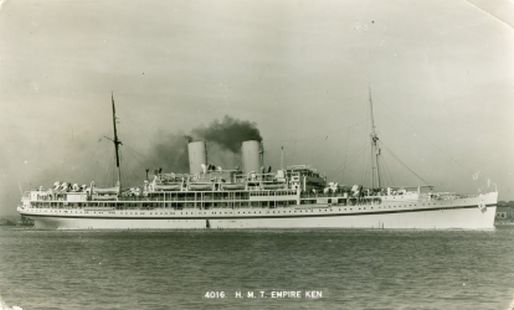
Empire Ken
This photo was supplied by Phil Booth, the caption reads:
The Ship that took my Grandad Randolph Shelby to Rhodesia
Africa
HMT. Empire Ken
9523tons, built 1928 Passenger ship.
1928 UBENA, German East Africa Line.
1939 German Navy, U-Boat depot ship.
1945 German hopital ship.
1945 Seized by Allies at Travemunde.
1945 EMPIRE KEN, MOWT troopship.
1957 Scrapped Dalmuir

Jim MacDonald has submitted this image: His
Bedding Card for the trip from Malta to Southampton aboard
Empire Ken in 1953.
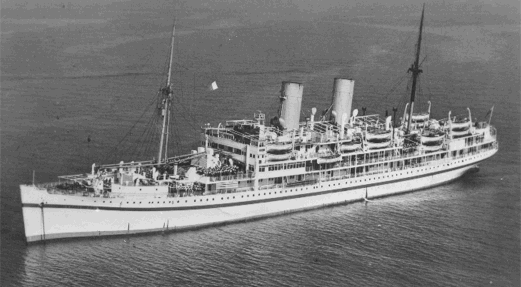
Another view of Empire Ken
|
Empire Medway
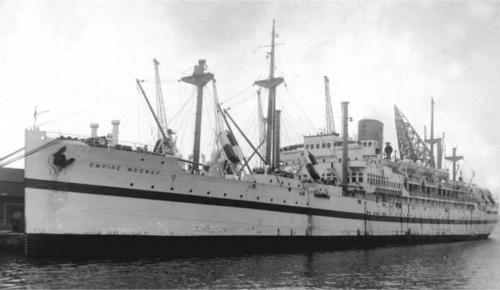

Postcard supplied by Janet Martin - It was sent by her father
while doing his National Service.
|
|
Empire Medway/Eastern Prince
EASTERN PRINCE (4) was built in 1929 by Napier & Miller
Ltd. at Glasgow with a tonnage of 10926grt, a length of 514ft,
a beam of 64ft 11in and a service speed of 16.5 knots. Sister
of the Northern Prince she was launched on 29th January 1929
and delivered in the following June. In 1932 she rescued the
crew of D. Falangas's Artemis which had run aground off Bahia.
During 1940 she made seven round trips between the UK and
Canada with children and civilian personnel before being converted
into a troopship at Liverpool on 20th-21st December. During
conversion she was damaged by German bombers but was commissioned
for 1200 men in the following June. In 1943 she was refitted
at Baltimore when US standee bunks were installed and her
capacity increased to 2150 men.
She was used as an accommodation ship during the Yalta Conference
in 1945 and on 30th March 1946 was acquired by the Ministry
of Transport for use as a troopship. Renamed Empire Medway
in 1950, with Prince Line as managers she was given a white
hull with blue band and yellow funnel and deployed between
Southampton - Gibraltar - Trieste or Cyprus - Port Said and
Lebanon. In November 1952 she arrived at Faslane where she
was broken up during 1953.
|
Empire Orwell
|
|
HMT. Empire Orwell - Operating life: 1936 - 1987 - Tonnage:
16,662 - Passengers: 490
Constructed: Blohm & Voss, Hamburg
Empire Orwell started her life as the Pretoria. During the
war she became a hospital ship and was used for the evacuation
of the Eastern territories in early 1945. Taken as a war prize
in Copenhagen in May 1945 she served as the Empire Doon under
Orient Line management until 1950 when she underwent a major
refit and became the Empire Orwell. She was sold to the Blue
Funnel Line in 1958 and became the Gunung Djati pilgrim ship
sailing between Indonesia and DJeddah. In 1979 she was sold
again to the Indonesian navy and spent her last years trooping
as the Tanjung Pandan. She was scrapped in Taiwan in 1987.
|
Empire Parkston
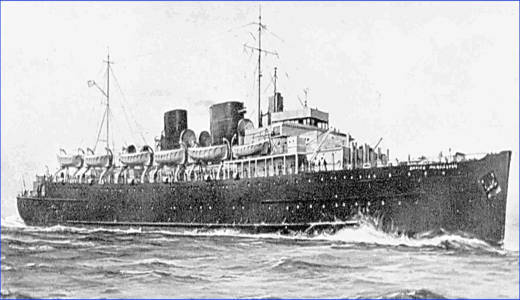
|
Empire Parkeston
Ex- Prince Henry, 1946 purchased from Canadian
Government and renamed Empire Parkeston, 1962 scrapped. 6,893
tons
MEMORIES "SNIPPETS" OF A RAMC MEDICAL
ORDERLY - Graham Hibbert
There are two troop ships that you hear very
little about, thy Empire Parkston and the Wansbeck, these
were known as ST's (sick tubs).
They operated a a night crossing several times a week from
Harwich to the Hook of Holland (for onward rail transport
to Germany) and return.
Medical staff consisted of two RAMC Lance-Corporals only,
provided by Netley on secondment to movement control Parkston
Quay Harwich, I spent several winter months on these ships;
we had a small medical room and were always busy. For serious
incidents we were totally reliant on any doctors and QA's
in transit and radio advice.
Unfortunately I do not have any photos, at the time these
ships did not have the sence of adventure and excitement as
deep sea trooping. - Graham Hibbert.
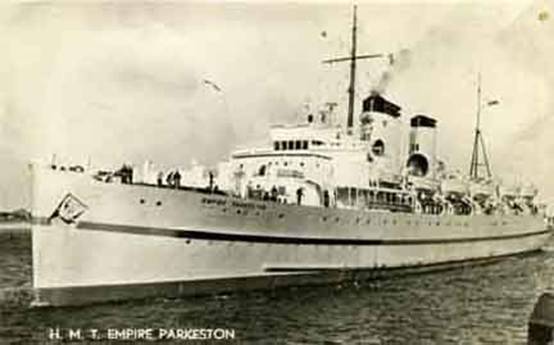
Another view of Empire Parkeston
|
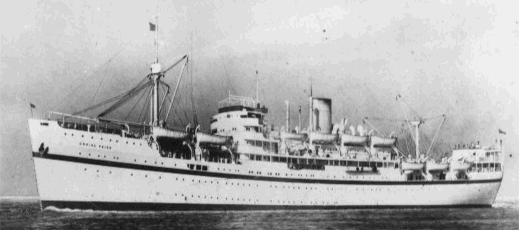
Empire Pride
|
Empire Pride
9248tons, built 1941 Troop Transport.
MOWT managed by Bibby Bros & Co.
1954 CHARLTON PRIDE, Chandris Ltd, London, converted to cargo
liner.
1956 CALGARIA, Donaldson Line, Glasgow.
1963 EMBASSY, Cia Nav.Fortaleza, Panama.
1963 Scrapped Hong Kong
|
Empire Star
|
Empire Star
Built: Harland-Wolffs, Belfast - Dimensions: 524.2 x 70.4
x 32.3 feet
Tonnage: Gross: 11093 Net: 6810
Propulsion: Two 6-Cyl. 2 S.C.D.A. Burmeister & Wain oil
engines by shipbuilder driving twin screws
Type: Refrigerated Cargo Liner
Launched: 26/9/1935 ( Yard No.957) as Empire Star for Frederick
Leyland & Co. Ltd. (Blue Star Line managers) - Completed:
12/1935
Bombed: 12/02/1942 and damaged by Japanese aircraft in the
Durian Strait, during the evacuation of Singapore. She received
three direct hits and repairs were later carried out at Fremantle
and Sydney, Australia. Fourteen military personnel and two
civilian refugees were killed
Torpedoed: 23/10/1942 and sunk by the German Submarine U-615,
north of the Azores in position 48.14N 26.22W [20]. She was
on a voyage from Liverpool to East London, South Africa with
10,555 tons of general cargo and Government stores. Twenty
crew , six gunners and six passengers were lost.
Sister Ships: Imperial Star (1) , New Zealand Star (1) , Sydney
Star (1) , Australia Star (1) , Melbourne Star (1) , Brisbane
Star (1), Wellington Star (1), Auckland Star (1), Adelaide
Star (1) , Empire Star (3) , Imperial Star (2) & Melbourne
Star (2)
|
Empire Test

S/S THYSVILLE in 1922
(Empire Test)
|
|
Belge-Maritime du Congo, Antwerp. 8176 tons.
1947 EMPIRE TEST, MOWT managed by Lamport & Holt Line -
troopship.
Scrapped Faslane in 1953 |
EMPIRE TEST / THYSVILLE 1922 - picture supplied
by Ron Flood - The Empire Test at Trieste Docks Italy, in
1952 with The South Lancashire Regiment aboard who were heading
for the Middle East.
8,300 gross tons, length 459ft x beam 57ft, one funnel, two
masts, twin screw, speed 14 knots. Accommodation for 178-1st
and 136-2nd class passengers. Built by John Cockerill, Hoboken
for Cie Belge Maritime du Congo, she was launched as the THYSVILLE
and commenced her maiden voyage from Antwerp to the Belgian
Congo on 2nd Oct.1922. In 1930 the company was merged into
Cie Maritime Belge (Lloyd Royal) and in 1940 on the invasion
of Belgium by the Germans, she was operated by the Belgian
Government on charter to the Allies. Acquired by the Ministry
of Defence in 1947 for relief trooping, she was renamed EMPIRE
TEST, and was painted white with a blue band round her hull,
yellow funnel and cream masts. There was capacity for 800
passengers/troops. Her final trooping voyage was in Oct.1952
and arrived at Faslane on 19th June 1953 for scrapping.
I sailed on this troopship from Trieste to
Port Sudan in October 1951 with the 1st Bn The South Lancashire
Regiment.The photograph showing it in Trieste was taken in
1951 not 1952. It was, of course coal burning and I remember
that once it arrived in Port Sudan a lighter came alongside
laden with coal. It was then unloaded into the bunkers by
hand with native labour (Fuzzy-Wuzzys) running up a series
of planks carrying baskets of coal. This process went on for
nearly three days until the lighter was empty.
Cheers
Gordon Clark
|

Another view of Empire Test - courtesy of www.photoship.co.uk
|
Empire Trooper

|
|
HMT. Empire Trooper
The EMPIRE TROOPER, ex CAPE NORTE ex SIERRA SALVADORE,
was an ex German 13,942 gross ton passenger steamer built
in 1922, by Stettiner Maschinbau AG Vulcan of Hamburg. When
built there was capacity for 2,886 passengers. On the 3rd
of September 1939, while attempting to return to Germany,
and in a position just off Peenambuco, Iceland, the vessel
was captured by H.M.S Belfast. During the capture the German
crew managed to sabotage the ships engines. Scrapped in 1955
|
Empire Wansbeck
|
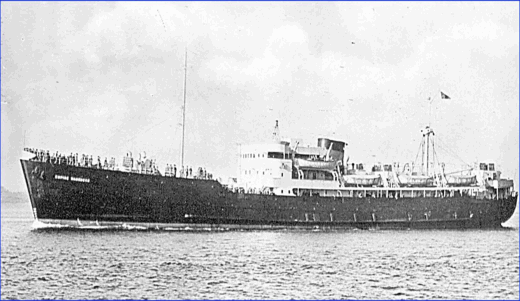
SS. Empire Wansbeck
Built 1943 ex- Linz, (North German Lloyd), war prize, 1946
renamed Empire Wansbeck, Harwich-Hook of Holland, 1961 sold
to Greece, renamed Esperos. 3,508tons
MEMORIES "SNIPPETS" OF A RAMC MEDICAL ORDERLY
- Graham Hibbert.
There are two troop ships that you hear very little about,
they were Empire Parkston and the Wansbeck, these were known
as ST's (sick tubs).
They operated a a night crossing several times a week from
Harwich to the Hook of Holland (for onward rail transport
to Germany) and return.
Medical staff consisted of two RAMC lance-corporals only,
provided by Netley on secondment to movement control Parkston
Quay Harwich, I spent several winter months on these ships;
we had a small medical room and were always busy. For serious
incidents we were totally reliant on any doctors and QA's
in transit and radio advice.
Unfortunately I do not have any photos, at the time these
ships did not have the since of adventure and excitement as
deep sea trooping. - Graham Hibbert.
|
Empress Australia
|
|
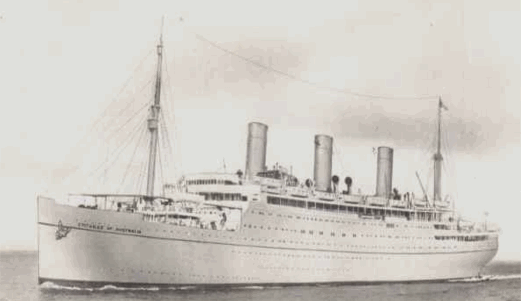
Empress of Australia
Built as TIRPITZ for Hamburg-Amerika Line by Vulcanwerke,
A.G at Stettin, Germany
21,861 GRT - 615 x 75 feet - Twin screw, turbines - 17 knots
370 First class, 190 Second Class, 415 Third Class, 1,000
Steerage
In 1938 she went to Harland & Wolff at Southampton for
an overhaul returning for the 1939 season, but after only
three cruisesshe was selected to act as the Royal Yacht to
take King George VI and the Queen to Canada. She sailed from
Portsmouth May 6, 1939and arrived two days late in Quebec
due to dense fog. She continued on the Quebec run until the
outbreak of War whereupon she became a troopship.It was in
this role that she would remain for the next 13 years. EMPRESS
OF AUSTRALIA worked world wide in trooping in every theatre
of war. In 1946 while anchoring off Liverpool her anchor tangled
with that of a cargo liner DEBRETT, the two ships collided
and seven tugs were needed to separate them. In December of
1946 she was altered for peace-time trooping, offering better
accommodations, however she was never repainted from the wartime
grey. She continiued to carry troops up to another overhaul
in Liverpool in 1951. The following year after her 70th trooping
voyage she was sold. Bought for scrap, she sailed from the
Mersey to Inverkeithing, May 8, 1952.
|
Empress Britain
|
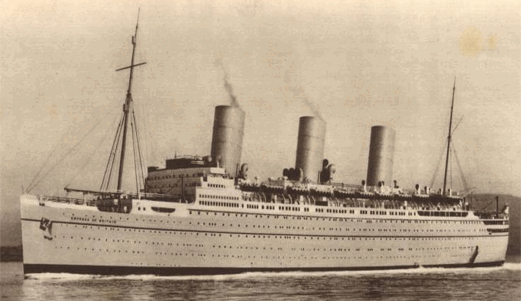
Empress of Britain
On the 25th Sept 1939, she was officially
requisitioned to be used as a troop transport. Once she had
been converted into such, she made two trooping crossings
from Halifax to Clyde, each time escorted by destroyers.
In March 1940, the Empress was sent to Australia and New Zealand
to transport troops to Europe. On May 12th she left Freemantle
in a troop convoy
The Empress of Britain burning after having been attacked
by German aircraft.
together with the Empress of Canada, Queen Mary, Aquitania,
Mauretania and Royal Mail’s Andes.
In the autumn of 1940, the Empress of Britain was on trooping
mission between England and Suez via the Cape. On her way
back, she called at Cape Town. Leaving with 643 people on
board, no one knew that this was to be her last voyage. On
October 26th, when the Empress of Britain was off the West
Coast of Ireland, she was suddenly attacked by a German long-range
Focke-Wulf Condor aircraft. The ship was set on fire in the
attack, and it did not take long before the crew had lost
control of the raging blaze. The Captain ordered abandon ship,
but a skeleton crew remained in an effort to save the ship.
The Polish destroyer Burza and the two tugs Marauder and Thames
managed to take the burning vessel in tow, and headed for
safe waters. But the German aircraft had reported the ship’s
position via radio, and soon the German U-boat U-32 was on
the Empress’ tails. The U-boat stalked its prey for
almost 24 hours before, on October 28th, she was able to fire
three torpedoes against the Empress of Britain. One of the
torpedoes detonated prematurely, but the other two found its
target, and mortally wounded her. The Empress of Britain went
down, the casualties being counted to 49, most of whom had
been killed in the air attack. Two days later, the U-32 was
sunk by the destroyer Harvester.
Five years later, when the bloody conflict of World War II
came to an end, no larger liner than the Empress of Britain
had been sunk. She was the greatest loss for the Allied forces
during the entire war.
|
Empress of Japan/Empress of Scotland
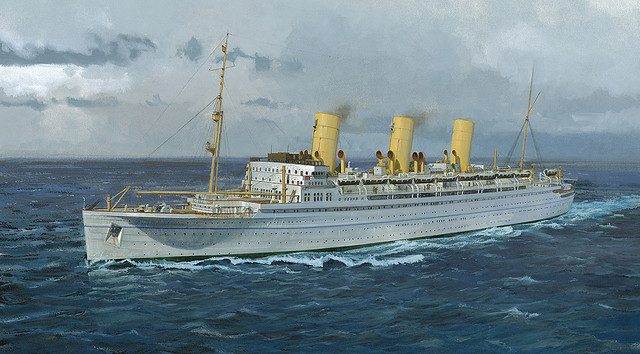
Built by the Fairfield Shipbuilding & Engineering Company,
Govan, in 1930 - Yard No: 634 Official Number: 161430 Signal
Letters: G M L V
Gross Tonnage: 26,313 Nett: 14,486 Length: 644 feet Breadth:
83.8 feet - Owned by the Canadian Pacific Railway Company
(Canadian Pacific Steamships - Managers) - 6 steam turbines,
single-reduction gearing to twin screws.Speed: 21 knots, max
23.
The EMPRESS OF JAPAN was built at the Fairfield Yard at
Govan at a cost of about £1.5 million. The ship's twin
screws were driven by Parsons' single-reduction geared turbines.
Six Yarrow oil-fired water tube boilers supplied steam at
425 lb/psi and 725 degrees superheat. The main engines developed
30,000 shp on five boilers (leaving one in reserve) for a
normal service speed of 21 knots. The third funnel was a dummy,
but served as a ventilator for the engine room, and the first
and second-class galleys.
On 26th November 1939 the EMPRESS OF JAPAN was requisitioned
as a troopship. She had been in Shanghai when war was declared
and after a crossing to Honolulu and Vancouver, she sailed
for Esquimalt where a certain amount of work was carried out
to fit her for trooping. Her hull and superstructure were
painted grey and she then left for Sydney, arriving on 22nd
December.
Shortly afterwards she sailed for Suez with a contingent
of Australian troops. Returning to Melbourne, she sailed again
with troops to Suez in the company of the QUEEN MARY, AQUITANIA,
MAURETANIA, EMPRESS OF BRITAIN and the EMPRESS OF CANADA.
In 1941 the EMPRESS OF JAPAN completed trooping voyages from
Glasgow to the Cape and Singapore, returning to the UK via
Panama: 35,000 miles in 141 days.
On 9th November 1944 the EMPRESS OF SCOTLAND was subject
to an air attack off Northern Ireland; three bombs being such
near misses that they actually glanced off the ship's rails
and a lifeboat, exploding in the sea. Captain J.W. Thomas
had given evasive-action orders to the quartermaster who swung
the wheel whilst lying on his stomach to avoid machine gun
bullets which were raking the bridge! Both men were later
decorated for their bravery.
Following the cessation of hostilities the EMPRESS OF SCOTLAND
continued trooping, repatriating troops and their families
until she was released at Liverpool on 3rd May 1948. During
the years 1939/1948, the EMPRESS OF SCOTLAND had steamed three
times round the world, twice westbound and once eastbound;
had sailed five times to South Africa and Singapore; and visited
Australia and New Zealand five times. She had called at Canadian
and U.S. ports on twelve occasions; sailed eight times to
India; and post-war twice to Japan. In all the EMPRESS OF
SCOTLAND had steamed 713,000 miles on war service and had
carried 292,000 troops as well as other passengers.

The EMPRESS OF JAPAN (by now renamed EMPRESS OF SCOTLAND)
as a troopship in the Second World War.
|
ETTRICK

|
ETTRICK - P. & O. Steam
Navigation Co Ltd, London
Ettrick MV was a British Passenger Motor Vessel
of 11,279 tons built in 1938 by Barclay Curle & Company,
Glasgow, Yard No 669 for the Peninsular & Oriental Steam
Navigation Company. She was powered by two five cylinder Doxford~type
opposed piston 2SCSA oil engines, diesels, twin screw, giving
20 knots. Engines by the shipbuilders. The vessel was on charter
to the Admiralty as a Troopship. On the 15th November 1942 she
was torpedoed by German submarine U-155 at 0315, 150 miles W
of Gibraltar.
She sank at 0836. She was on a voyage from Gibraltar to the
Clyde in ballast, with a crew of 204, 66 naval ratings, and
41 gunners. 18 naval ratings and 5 Asian crew were lost; another
Asian seaman died of his injuries. Survivors were taken to Gibraltar
by the Norwegian destroyer HMS GLAISDALE (L44) and returned
to the UK in P&O´s MOOLTAN the following day.
(The large luxury troopship the 'Ettrick' at Southampton dock.
L/S's and M/S's of the 2nd battalion Shropshire light infantry
boarding the ship. Good footage of the soldiers waving from
the deck of the ship as she embarks for the West Indies on her
maiden voyage.
|
SS. Euripides - Aberdeen Line

|
|
EURIPIDES / AKAROA 1914
The EURIPIDES was a 14,947 gross ton ship built in 1914
by Harland & Wolff, Belfast for the Aberdeen and Commonwealth
Line. Her details were - length 550.7ft x beam 67.4ft (167,85m
x 54,00m), one funnel, two masts, refrigerated cargo space,
triple screw and a speed of 15 knots. There was accommodation
for 140-1st, 334-2nd and 750-3rd class passengers. Launched
on 29th Jan.1914, she was the company's largest ship and made
a "shake down" cruise in June with guests. Her maiden
voyage from London to Brisbane started on 1st July and she
arrived on 24th August.
On 26th Aug.1914 she was taken over at Brisbane for Australian
trooping duties, but reverted to UK government control in
1915 and continued London - Australia voyages, her third class
accommodation being used mainly for troops. In Feb.1919 she
commenced repatriating Australian troops, and during this
and her war service steamed 208,307 miles and carried 38,439
troops.
After overhaul at Belfast she resumed the Aberdeen Line's
London - Australia service in Nov.1920. In March 1923 she
made the company's last inbound call at Plymouth and subsequently
sailed direct to Southampton. She was laid up in the Clyde
for five months in 1927 and then went into the Liverpool -
Australia joint service of the Blue Funnel and White Star-Aberdeen
Line.
In 1929 she was transferred to White Star's Oceanic Steam
Navigation Co managemant and in July 1932 was taken over by
Shaw Savill & Albion. Rebuilt to 15,128 gross tons by
Hawthorn Leslie & Co, and with accommodation for 200-cabin
class passengers she was fitted with a swimming pool, her
3rd class accommodation converted to cargo space, her engines
converted from coal to oil burning and she was renamed AKAROA.
She entered Shaw Savill & Albion's Southampton - Panama
- Wellington service on 28th Feb.1933 and in November made
her fastest passage to New Zealand in 37 days.
Between 1939-45 she remained in commercial service under
the Ministry of War Transport and was reconditioned on the
Tyne in 1945 to 15,320 gross tons and with accommodation for
190-cabin class passengers. Her final sailing to Wellington
started on 2nd Jan.1954 and in May of that year she went to
shipbreakers at Antwerp.[Merchant Fleets by Duncan Haws, vol.17,
Aberdeen and Aberdeen & Commonwealth Lines]
|
Franconia
|
SS Franconia.
Built 1923 by John Brown Clydebank, - Yard
No 492 - Engines by Shipbuilder
Port of Registry: Liverpool - Propulsion: Steam turbine, twin
screws, 13500shp
Launched: Saturday, 21/10/1922 - Ship Type: Passenger Vessel
Ship's Role: N.Atlantic and cruising
Tonnage: 20155 grt - Length: 624 feet - Breadth: 73 feet
Owner History:
Cunard Steam-Ship Company, Liverpool
1934 Cunard-White Star Ltd., Liverpool
1950 Cunard Steam-Ship Co., Liverpool
Status: Arrived for Scrapping - 18/12/1956 |
Georgic
|
Georgic (II) 1932 - 1956
Length: 712 feet (217.5 m) Beam: 82.5 feet (25.2 m) Tonnage:
27,759 gross tons
The Second World War began in 1939, and the Georgic was
requisitioned for British trooping duties. Earlier the same
year the Georgic had been transferred back to the Liverpool-New
York service and made five voyages back and forth. The actual
converting into a trooping-vessel did not occur until April
1940, on the Clyde. The Georgic was now able to carry 3,000
soldiers. The first use that was made of the Georgic was to
have British troops evacuated from Andesfjord and Narvik in
Norway and landing them at the Clyde. The next assignment
was to evacuate British soldiers from Brest and S:t Nazarie.
She also carried Canadian troops across the Atlantic to the
Middle East via the way around Africa.
In 1941, the Georgic was sailing in a convoy that had left
the Clyde on May 22. This convoy was the very convoy, which
hunted and sank the famous German battleship Bismarck. After
having been left almost unprotected by the attacking British
war-ships, the Georgic anyway managed to reach her destination:
Port Tewfik in the Gulf of Suez on July 7. When she was at
anchor here, German aircraft spotted the British trooper and
bombed her. The Georgic was hit twice, and the stern of the
ship was set afire by the bombs. The fire reached the ship’s
fuel, and the ammunition carried on board exploded, thus wrecking
the entire stern area. The ship was beached by her captain,
and when evacuated the half-submerged Georgic was left to
be burned out.
Even though the vessel was almost totally destroyed, it
was decided that she should be salvaged on September 14. In
October the Georgic was raised, and two months later the plugging
of the hull was completed. She was towed, stern first, to
Port Sudan where she was made seaworthy. A year later she
had arrived at Bombay and finished hull cleaning and further
reparations. In January 1943, she left Bombay at 16 knots
for Liverpool where she arrived on March 1. Her next port
of call was Belfast. There she would undergo a complete refit,
which took 17 months. When completed in December 1944, her
exterior was much different from what she had once looked
like. The main changes was that her fore funnel and aft mast
had been removed and the forward mast been shortened. Now
every possible difficulty in separating Georgic from her sister
Britannic had been reduced. On December 16, she was returned
to her managers. During the last year of the war, the Georgic
made some trooping to Italy, the Middle East and India. The
last war duties continued until 1948.
The Georgic was offered for sale in 1955, and in May she
was chartered by the Australian Government. The last voyage
ever completed in service for the Georgic was on November
19, when she carried 800 troops between Hong Kong and Liverpool.
In December she was laid up at Kames Bay at Isle of Bute,
and in January 1956 she was sold to the Shipbreaking Industries
Ltd. at Faslane where she arrived one month later. The last
of the ships built for the White Star Line had finally come
to rest.
|
Highland Monarch
|
Highland Monarch - 14,139tons - Built at Harland & Wolff,
Belfast - 1932-1960 - Steel Screw motorship
Highland Monarch was built for Nelson Line in 1928. She
passed to Royal Mail in 1932, with the take over of Nelson
Line. Highland Monarch was scrapped in 1960.
|
Highland Princess
|
Highland Princess 14,100 Harland & Wolff, Belfast 1932-1959
Steel Screw motorship
Highland Princess was built for Nelson Line in 1929. She
passed to Royal Mail in 1932, with the take over of Nelson
Line. In 1959 Highland Princess was sold to John Latsis, Piraeus,
and renamed Marianna
|
Highland Chieftain

|
Highland Chieftain
(Royal Mail: 1932-1958 - 14,131gt)
Highland Chieftain was built by Harland and Wolf of Belfast
for Nelson Line in 1928, the first of the five "Highland"
Class. Sister ships were Highland Brigade, Highland Monarch
and Highland Princess. Her maiden voyage on the London to
River Plate service, on the 21st of February and later transferred
to Royal Mail in 1932. She commenced wartime trooping duties
in 1939, but was damaged on the 11th of October, 1940, during
a bombing raid on Liverpool.She ran aground in 1946. In 1959
Highland Chieftain was sold to Calpe Shipping Co, Gibraltar,
and renamed Calpean Star.
The Fate of this Ship.
As you come up the River Plate to Montevideo you can see
the mast of the Highland Chieftain sticking out of the water
from miles away. The un-initiated on the ship thought that
this was the remains of the Graff Spee. No such luck as she
lies broken up underwater some 3 miles away. After the war
she did not resume her commercial operations until 1948 on
the River Plate service, and was sold out of the fleet in
January of 1959 to the Calpe Shipping Company of Gibraltar
and converted for use in the whaling industry,and renamed
Calpean Star.
In March of 1960 she suffered rudder damage when off Montevideo,
and after leaving under tow she suffered a boiler room explosion
which resulted in her being abandoned.The wreck wasn't cut
up for scrap until 1965.
She took webmasters brother Charles Petvin (RAF) to North
Africa in 1943
With thanks to Andrew Faulkner
|
SS Ivernia
|
|
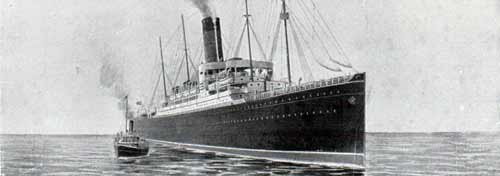
SS IVERNIA
Ivernia was built in 1900, by C.S. Swan & Hunter Ltd.
in Newcastle. She was the sister ship to Saxonia. Her tonnage
was 14,058 tons gross, 11,057 under deck and 9,052 net. She
was 582 feet long with a 64.9 foot beam and holds 37.8 feet
deep; She had twin screws, 4 masts, 3 steel decks. The upper
and main decks were partly sheathed in wood. Steel orlop deck
forward, orlop beams aft, steel shelter deck were also sheathed
in wood. She was fitted with electric lights and refrigerating
machinery.
There was a cellular double bottom, aft 163 feet long, under
engine and boilers 113 feet amidship and forward 205 feet.
Propulsion came from a quadruple expansion steam engine with
8 cylinders operating at 210 p.s.i.; 1,668 nominal horsepower;
9 single ended boilers; 27 corrugated furnaces. The engine
was built by Wallsend Slipway Co. Ltd. in Newcastle.
At the time of her construction, Ivernia had the largest
funnel of any vessel afloat. At 60 feet in height, it was
as large as the later 52,000 ton German Imperator’s
funnels. Ivernia had accommodations for 164 First class, 200
Second class, and 1600 Third class passengers. She started
on her maiden voyage from Liverpool to New York on April 14th
1900. Her normal service was Liverpool – Queenstown
(Cobh) – Boston.
Following the outbreak of World War I in August 1914 the
Ivernia was hired by the British government as a troop transport
and was placed under the command of Captain Turner (made famous
for being the captain of RMS Lusitania at the time of her
sinking).
At the time of the attack the Ivernia was carrying about
2,400 troops of the Argyle & Sutherland Highlanders, Royal
Scots Fusiliers, Rifle Brigade and Yeomanry. Of these three
officers and 82 other ranks were drowned. The ship's surgeon,
the chief engineer and 34 of the crew were also drowned.
At 10:12am on 1 January 1917 the Ivernia was torpedoed by
the German submarine UB-47 58 miles south-east of Cape Matapan
in Greece. Within one hour the ship sank. HMS Rifleman rescued
a number, and armed trawlers towed the bulk, who had taken
to lifeboats, to Suda Bay in Crete. Over 120 lives were lost
from the sinking.
|
Imperator
|
SS. Imperator - Launched 05-23-1912, Vulcan
Shipyards, Hamburg
Gross Tonnage - 52,226, Dimensions - 269.09 x 29.96m ,Number
of funnels - 3Number of masts - 2, Builder - A.G.Vulcan, Hamburg,
Commisioned 05-24-1913Size: 52.117 gross tons (European);
15,000 tons., Length over all: 277.06 m (269.07 registered),
Width: 29.87 m, Depth: 19.20 m, Machines: 4 turbines AEG-Vulcan,
Speed: 23 knots normal, 24 knots maximum, Capacity: 714+194
first class, 401+205 second class, 962+1772 third class passengers,
1180 crew. 1938 sold for scrap
As the cost of renovation would be so high it was decided
to withdraw the Berengaria from service altogether, on 23
March 1938. For the next few months she lay idle in Southampton
dock until 19 October when it was decided to dispose of her.
Sir John Jarvis MP bought the ship for demolition on the Tyne
at Jarrow for £108,000. The ship sailed from Southampton
on December. The furniture and fittings were auctioned in
January 1939 and over 200 Jarrow men were employed in breaking
up the old ship. The outbreak of war, however, meant that
the men were required elsewhere so it was not until 1946 that
the remains of the hull were towed to Rosyth for the final
process of dismantling. By this time few people were interested
in the remains of an old liner that had been built in the
Imperial Germany of 1913.
|
Ile De France
|
Ile De France
The ship was involved in extensive trooping during World
War II. Returned to the French Line in 1947, she underwent
a massive two-year reconstruction which modified her profile
with the removal of one funnel, giving her a more modern appearance.
She was also given some of the furnishings of the Normandie,
which had been destroyed by fire in 1942.
|
Laconia
|
|
RMS Laconia
Owner: Cunard Line - Port of registry: Great Britain
Route: Liverpool-Boston-New York route
Builder: Swan, Hunter & Wigham Richardson Ltd, Wallsend-on-Tyne
Launched: 9 April 1921 - Maiden voyage: 25 May 1922
Fate: Torpedoed and sunk on 12 September 1942
General characteristics
Class and type: Ocean liner - Tonnage: 19,860 gross tons
Length: 183 m (600 feet) - Beam: 22.5 m (74 ft)
Installed power: Steam turbines - Propulsion: Twin propellers
Speed: 16 knots
Capacity: Passenger accommodations: 350 1st class - 350 2nd
class - 1,500 3rd class
|
Lancastria
|
SS. Lancastria - sunk at St Nazaire 17th June 1940
Name: RMS Tyrrhenia (1920–24) -RMS Lancastria (1924–40)
HMT Lancastria (1940)
Owner: Cunard Line Builder: William Beardmore and Company
Launched: 1920
Maiden voyage: 19 June 1922 - Out of service: 17 June 1940
Nickname(s): as Tyrrhenia her crew called her
"Old Soup Tureen"[1]
Fate: Sunk by air attack on 17 June 1940 - Notes: 3,000 to
5,800 total dead
1,738 identified (named) dead - 2,477 survivors
Tonnage: 16,243 GRT p- Length: 578 ft (176 m) - Beam: 70
ft (21 m)
Height: 43 ft (13 m) - Draught: 31.4 ft (9.6 m)
Decks: 7 decks and a shelter deck
Installed power: 6 steam turbines, 2,500 nhp - Propulsion:
twin screw
Speed: 16.5 knots (31 km/h; 19 mph) - Capacity: 1,300 passengers
3 cargo holds:
438,000 cubic feet (12,400 m3) Grain Capacity
400,000 cubic feet (11,000 m3) Bale Capacity
29,000 cubic feet (820 m3) Refrigerated
Crew: 300
Notes: Sister ship: RMS Cameronia
|
Lancashire
|
|
HMT. Lancashire (2)
Built 1914 for Bibby Line, in 1930 converted to permanent
troopship, scrapped at Barrow in 1956. Length 502 ft. Breadth
57 ft. Depth 35 ft. 10 ins. Tonnage 9,543 tons, H.P. 6,000.
Lancashire took my father to Malta in April 1934. They appeared
to have arrived at Malta on 22/04/1934. He was posted to RAF
Flying Boat base at Calafrna, attached to 202(FB) Squadron.
Lancashire seems to have taken service personnel as far as
India and was out in the far east at the fall of Singapore.
I also have heard it was still in far east service (pos.
Hong Kong) as late as 1956. (Roy Haskett)
|
|
Another view of HMT. Lancashire - supplied by B J Jayne.
I sailed on the last voyage of the Lancashire, Embarking
with the HQ Ist guards Brigade at Port Said at the end of
March 1956 arriving in Liverpool approx 14 days later, she
suffered a minor engine problem resulting in a short stay
in Grand harbour Malta, She left Liverpool to go to the Breakers
Yard.
Regards B J Jayne Welsh Guards (ret)
|
Laurentic
|
SS Laurentic was a British ocean
liner of the White Star Line.
Career - Name: SS Laurentic
Owner: White Star Line Ordered: 1907
Builder: Harland and Wolff - Yard number: 394
Launched: 1908 - Maiden voyage: 29 April 1909
Fate: Struck two mines and sank, 25 January 1917
General characteristics - Tonnage: 14,892 Gross Register Tonnage
Length: 565 ft (172 m) Beam: 67 ft 3 in (20.5 m)
Decks: 3
Installed power: Triple-expansion steam engines driving outboard
propellers, with low-pressure turbine driving the centre propeller.
Total 11,000 indicated horsepower.
Propulsion: Triple screws - Speed: 16 kn (30 km/h; 18 mph)
Capacity: 1st Class: 230; 2nd Class: 430; 3rd Class; 1,000
Laurentic was launched in 1908 and entered
service between Liverpool and Montréal on 29 April 1909.
She only ever served on the Liverpool-Canada route, and gained
notoriety in the capture of murderer Hawley Harvey Crippen,
in which Chief Inspector Walter Dew of the Metropolitan Police
used the Laurentic's speed to arrive in Canada before the fleeing
suspect on the SS Montrose.
Being in Montréal when the Great War began, Laurentic
was immediately commissioned as a troop transport for the Canadian
Expeditionary Force. After conversion to armed merchant cruiser
service in 1915, she struck two mines off Lough Swilly in the
north of Ireland on 25 January 1917 and sank within an hour.
Only 121 of the 475 aboard survived.
In addition to her passengers and crew, the ship was carrying
about 35 tons of gold ingots stowed in its second class baggage
room. At the time the gold was valued at £5 million, approximately
£250 million in 2007. Royal Navy divers made over 5,000
dives to the wreck between 1917 and 1924 and recovered all but
about 1% of the ingots. Still to this day 22 bars of gold remain
on the sea bed, perhaps under parts of the hull, the last of
the gold recovered by the Royal Navy was some 10 metres (33.8
feet) under the sea bed, thus the remaining gold would be difficult
to reach.
|
Empire Clyde
|
LEONARDO DA VINCI (Empire Clyde
1)
1925 LEONARDO DA VINCI, Transatlantica Italiana
Soc.di Nav, Genoa.
1937 Lloyd Triestino, Trieste.
14.2.41 Captured by R.N at Kismayu, Italian Somaliland.
1941 MOWT managed by Ellerman Lines.
1943 EMPIRE CLYDE (1), managed by Ellerman City Line - Hospital
Ship.
1948 MAINE, The Admiralty. Hospital Ship.
1954 Scrapped Hong Kong. |
Llangibby

Llangibby Castle
Name Llangibby Castle
Type: Troop transport
Tonnage 11.951 tons
Completed 1929 - Harland & Wolff Ltd, Govan, Glasgow
Owner Union-Castle Mail SS Co Ltd, London
Homeport London
Llangibby Castle (12053 tons) was torpedoed by U-402 (Lt at
46.04N, 19.06W - Grid BE 5716) while part of convoy WS15.
At 11.15 hours on 16 Jan, 1942, the Llangibby Castle (Master
Bayer) was torpedoed by U-402 north of the Azores. One torpedo
hit the stern and blew away the after gun and the rudder,
but the propellers remained intact. The ship limped to Horta
in the Azores at 9 knots, fighting off attacks by German Fw200
aircraft on the way. The neutral Portugal allowed only 14
days for repairs and on 2 February, the ship had to leave
with the troops still on board and set course to Gibraltar,
assisted by an Admiralty tug and escorted by three British
destroyers.
On 3 February, the small convoy was followed by several U-boats,
but none managed to hit the ship, while the HMS Westcott (D
47) sank U-581 (Pfeifer). On 8 February, the troopship arrived
at Gibraltar in tow of the tug and disembarked the troops.
On 6 April, the Llangibby Castle left Gibraltar under escort
after temporary repairs, but still without rudder, for the
UK, arriving on 13 April. Altogether she sailed 3400 miles
without a rudder and with a badly damaged stern, only using
her engines for steering, a feat for which her master was
awarded the OBE.
I was searching through the list of troopships (WW) looking
for for a ship which I think was called Llangliby Castle.
I sailed aboard her, with other Royal Navy personnel, from
Greenock Sept.13th 1943. She was designated MHT G3. Finshed
the journey Durban. Is there any info. about this transport
available?
Sid Browne. 113 Thirteenth Street, MILDURA. Vic. Australia.3500.
Her Service Career
Three years later the last of the “LLANS ” appeared,
the LLANGIBBY CASTLE of 12 000 tons. She was really just an
enlarged sister to the original pair but was a motorship,
the first to appear in the intermediate fleet of the Union-Castle
Line, and the first in the “Round Africa” service.
Built by Harland and Wolff of Belfast, but in their shipyard
at Govan, Glasgow, she was, as Marischal Murray points out
in his book “Ships and South Africa”, built for
an English firm by an Irish Company in Scotland and with a
Welsh name! She was the finest of the “LLANS”,
perhaps not in looks but certainly in the luxury of her cabins,
wide deck space and speed. In appearance she resembled the
mailship CARNARVON CASTLE of 1921 except that her boats were
slung above deck-level as in the mailships WINCHESTER CASTLE
and WARWICK CASTLE, which appeared a few months after she
did. She became exceedingly popular in the Round Africa service
and also in the West Coast intermediate service. She carried
450 passengers in two classes.
She had an eventful life during the war (1939 – 1945),
taking part in many dangerous convoy trips. In January 1942
she was a unit in a convoy rushing troops to Singapore. She
had 1500 of them on board. In the morning of January 16, four
days after leaving Britain, she was hit on her stern by a
torpedo, which destroyed her rudder , blew her stern gun overboard
and killed 26 men. The weather was bad, a strong wind blowing
and the waves were high. Captain R.F. Bayer was instructed
to make for the Azores independently, in itself a very dangerous
move. Fortunately neither of the propellers had been destroyed
so the ship could be steered, although with great difficulty,
by “jockeying” the screws. Three hours later the
LLANGIBBY CASTLE was again attacked, this time by a long-range
plane which dropped bombs, which fortunately missed, and by
machine-gun fire which wounded the ship’s bosun. The
vessel’s A.A. guns hit back and the attacker was hit
and made off with black smoke streaming from it.
It took the LLANGIBBY CASTLE three days to cover the 700
miles to the Azores, but on January 19 she reached Horta Bay,
where the Portuguese authorities gave the ship 14 days in
which to make repairs. There were no proper repairing facilities
at Horta, nor were any of the troops nor the ship’s
company allowed ashore (except for the captain, on business!),
but all hands enjoyed seeing the lights and having the ports
of their cabins open, after the normal “black-out”
conditions in Britain and at sea.
Meanwhile the R.N. was making arrangements to succour the
ship. On February 1 three destroyers and an Admiralty tug
arrived, to escort the LLANGIBBY CASTLE on the next stage
of veritable battle occurred, with U-boats that had been waiting
for the liner and escorting destroyers fighting it out with
guns, starshells, depth-charges and torpedoes. Meanwhile the
LLANGIBBY CASTLE had been having trouble in steering, , so
she was taken in tow by the tug. After daylight she cast off
the tug and again proceeded under her own steam, steering
a rather “wobbly” course which, however, served
as the necessary zig-zags which were compulsory for ships
in submarine-infested waters! The destroyers managed to keep
the U-Boats at bay until four days later, when land was sighted
and the tug again took the liner in tow. On 8 February she
anchored safely at Gibraltar, where her passengers were disembarked
to wait for another vessel. Then followed a long period of
just over 8 weeks at Gibraltar while decisions were being
made in high quarters about the vessel’s future. It
was found impossible to replace the ship’s rudder, so
apart from some strengthening of her stern she was in much
the same state as before. Finally she was ordered to return
to Britain. This last haul of nearly 1500 miles was done safely
in six days, the ship steaming by herself except for a few
hours in the Straits of Gibraltar when she was towed by the
tug. In all she had steamed about 3400 miles without stern
or rudder and got through it all safely, which must be a record!
After full repairs she resumed service as a troopship and
was one of the great armada that brought Allied soldiers to
French North Africa in November 1942. In the early hours of
8 November she was hit by an 8? shell fired from a shore battery
which destroyed the Engineers quarters, killing one Electrician
and wounding two Engineers. She replied with her stern 6?
gun and after some 16 shells had been fired at only 4 500
yards range the battery ceased fire. When her troops were
disembarked she, with the WARWICK CASTLE, WINCHESTER CASTLE
and DURBAN CASTLE and several other troopships made an unescorted
dash for Gibraltar. Most of the ships got through safely,
but a major casualty was the beautiful P. & O. Liner VICEROY
OF INDIA (1929; 19648 gr. tons), one of the pioneers of turbo
electric propulsion for liners, which was torpedoed on 11
November 1942. Next day the homeward convoy sailed from Gibraltar,
for England, which was reached in safety several days later.
When in July 1943 the “soft underbelly of Europe”
was attacked in accordance with Churchill’s plans the
LLANGIBBY CASTLE was there again. She brought a contingent
of Canadian commando troops to Sicily and, in spite of bad
wind and weather, saw them safely onto the shore.
In March 1944 the LLANGIBBY CASTLE was sent unexpectedly
to the Clyde where she was fitted out as a Landing-Ship, Infantry
(Large). Her boats had already been replaced by assault landing-craft,
now she was painted in a new style of dark and light blue
camouflage, and the Royal Marine Flotilla 557 embarked. The
ship then sailed, via Milford Haven, for the Solent. There
she and a huge number of other ships were exercised with as
much secrecy as possible in night manoeuvring, anchoring in
formation, shipping landing craft and, of course, signalling.
She then received the troops she would carry for her greatest
operations so far, the attack on Hitler’s “Festung
Europa” and with them made an “invasion”
of the English coast at Bracklesham. Her troops were again
Canadians, the Regina Rifles, the Winnipeg Regiment and some
unattached personnel. The 120 men of the Marine Flotilla party
were also on board. For a week before “D-day”,
the ships and their crews and passengers were isolated from
shore for security reasons.
There was one more delay when bad weather on Sunday, 4 June,
1944, caused the Supreme Commander of the great invasion force,
General Dwight Eisenhower, to postpone the sailing of the
invasion of the fleet for one day. But on the next day the
armada set forth, with the greatest number of ships under
cover of the greatest number of aircraft ever used for one
undertaking. The LLANGIBBY CASTLE was taking her precious
cargo of about 2 500 fighting-men to “Juno” beach
on the coast of Normandy. As each ship of the Southampton
fleet passed the huge Nab Tower in the Solent its personnel
gave a great cheer, as there was a gigantic “V”
in electric lights shining towards the oncoming ships: Churchill’s
“V” for Victory sign, to encourage the troops!
Following the huge flotilla of 250 minesweepers which was
making certain that no hidden perils in the sea would sink
any of the ships, the LLANGIBBY CASTLE and her consorts steamed
in safety towards the enemy-held coast, while friendly aeroplanes
prevented any possible attack by the Luftwaffe. Soon those
in the ships could see the vivid flashes of gunfire and exploding
bombs and shells on the coast to which they were sailing.
As 05h30 next morning, as planned, the LLANGIBBY CASTLE anchored
off Coursailles on the Normandy coast. At last the “Second
Front”, so long discussed and longed for, was a reality.
By this time all the troops on board had already taken their
places in the 18 L.C.A.’s (Landing Craft Assault) which
the ship carried in lieu of her boats, and within 3,5 minutes
all the landing craft were on their way to the shore. As not
all o return to the ship to pick up the rest. these had to
slide down canvas “Shutes” or climb down nets
suspended overside, but at last all were landed. The cost:
ten landing-craft eventually destroyed with the loss of 12
officers and men of the liner.
She had carried the biggest contingent to that particular
part of the beach, so it was not until 14h15 that all were
ashore. By 15h00 she and the rest of her division could weigh
anchor and return to Southampton, where her crew could listen
to the radio reports about the men she had carried.
Then came the great build-up of troops in Normandy, all
of whom had to be carried over by ships. Thus the LLANGIBBY
CASTLE crossed the channel more than sixty times, carrying
more than 100 000 troops, a wonderful record. Incidentally,
in all these operations she frequently met her former colleague
in the “Round Africa” service, the LLANDOVERY
CASTLE, which had been taken over for use as a hospital-ship,
just as her predecessor of 1914 had been.
When peace had finally been restored the LLANGIBBY CASTLE
was one of the many British liners which, after much hazardous
and valuable war service, had to be refitted for her proper
role. In 1946 she rejoined the Union-Castle Fleet and again
sailed in the “Round-Africa” service. But newer
and larger ships were built for this purpose and so in 1954
this grand vessel, once the pride of her owners, was sold
to British ship breakers to produce scrap-metal for British
industries.

Thanks to the Stamps of Helena
With thanks to Bruce Dennis.
|
RMS Majola
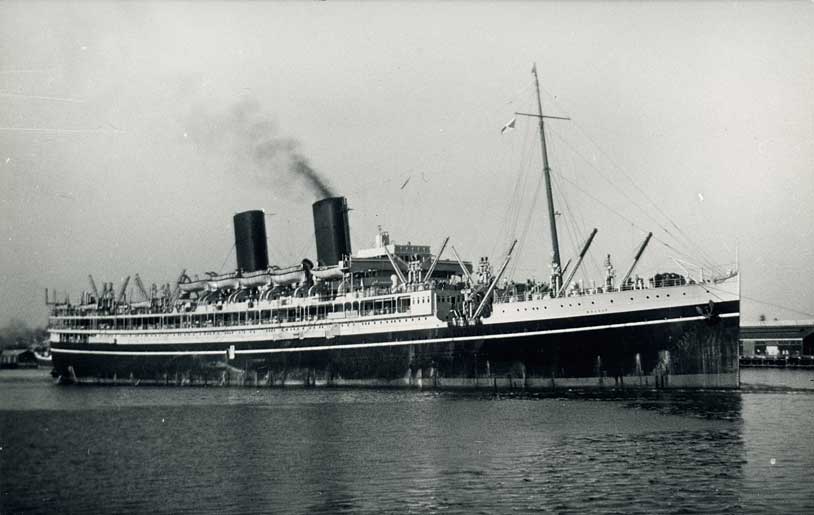
|
19 Apr 1923: Launched by Harland
and Wolff - Christened by Miss Elsie Mckay
25 Oct 1923: Completed trials and delivere
11 Sep 1939: Requisitioned by the admiralty for service in WW2
- converted to an armed cruiser at Bombay. At some time during
the war the second dummy funnel was removed as it impeded the
anti-aircraft gun
6 Nov 1941: Returned to owner for use as a troopship
15 Jan 1947: Returned to P & O and reconditioned
10 Jun 1948: Returned to commercial service
2 Apr 1954: Sold to British Iron and Steel and scrapped at Inverkeithing
Displacement: 20914 BRT
Armament: 8x 152mm, 2x 76mm
Speed: 17 knots
Wartime requisition
On 11 September 1939 Maloja was requisitioned
by the Admiralty and converted to an armed merchant cruiser
in Bombay, India. The conversion included having one funnel
removed, to increase her anti-aircraft guns' arc of fire. After
the conversion she joined the Northern Patrol as HMS Maloja
(F26). The Northern Patrol covered the area between Shetland
and Iceland. On 13 March 1940 Maloja intercepted a ship southeast
of Iceland in position 63.00N, 10.20W, which claimed to be the
Japanese vessel Taki Maru. Maloja's captain suspected otherwise,
but he was unable to send a boarding party due to the adverse
weather conditions. As the weather cleared it became clear that
the unknown vessel was the German La Coruña of the Hamburg-South
America Line. The German crew scuttled her to evade capture,
and after they had abandoned ship and been picked out of the
water by the British crew, Maloja turned her guns on the German
ship and hastened its sinking.
On 6 November 1941 Maloja was returned to P&O and was converted
to troopship duty. A shorter version of the funnel was re-installed.
Described by one passenger, as "very crowded" (with
troops) she sailed from Liverpool on 28 July 1942 for Calcutta,
but heading first for Greenock on the Firth of Clyde (arriving
29 July) to join the rest of the convoy, which included seven
battleships and destroyers. The convoy left the Clyde on 30
July. On Monday, 10 August the Maloja anchored at Freetown,
Sierra Leone until 15 August. While at Freetown the convoy was
joined by two battleships, and a further three US ships joined
on 18 August. She put in at Cape Town on 27 August and left
on the 30th. She arrived in Calcutta on 19 September 1942.
In December 1942, some weeks after Operation Torch, she took
Allied troops to North Africa. According to the records of No.255
Squadron, RAF, the vessel sailed from Liverpool at 13:00 on
27 November 1942.
|
RMS Mooltan

|
|
MOOLTAN (1923) was the first P&O ship over 20,000 gross
tons. All her cabins were above the main deck, all of them
had portholes, and there were special suites on the promenade
deck in Louis XVI style.
War Service
Navy The Royal Navy -Type Armed Merchant Cruiser - Pennant
F 75
Built by Harland & Wolff Ltd. (Belfast, Northern Island)
Launched 15 Feb 1923 - Commissioned 15 Oct 1939
On 9 September 1939 the passenger ship Mooltan of the P. &
O. Steam Navigation Co Ltd, London was requisitioned by the
Admiralty and converted to an armed merchant cruiser. Conversion
was completed on 15 October 1939.
Displacement: 20952 BRT
Armament: 8x 152mm, 2x 76mm
Speed: 17 knots
Career:
October 39 - April 40: South Atlantic Station
May 40: Freetown Escort Force
June 40 - July 40: South Atlantic Station
August 40 - January 41: Freetown Escort Force
On 20 January 1941 returned and used as troopship by the
Ministry of War Transport (MoWT). On 16 July 1947 returned
to owner. Transported migrants to Australia in the early 50's.
|
Nevasa
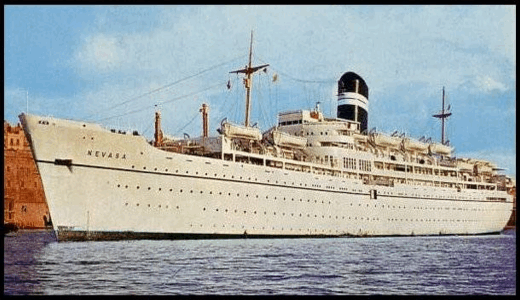
|
HMT. Nevasa
Built to celebrate the company's centenary in 1956, SS
Nevasa spent her first few years trooping. However, as National
Service came to an end and air transport became more efficient,
the ship was made redundant and laid up in the River Fal in
1962 for two years. SS Nevasa was converted to B.I.'s third
and largest educational cruise ship at Falmouth in 1964/5.
Her powerful machinery gave her a greater range than the other
educational cruise ships and her anti-roll stabilisers provided
greater comfort. She ran alongside the SS Uganda between 1968
and 1974. However the SS Nevasa was suddenly withdrawn in
January 1975 and sent to breakers in Taiwan, a victim of the
1970's oil crisis.
|
|
HMT Nevasa
The earlier Nevasa which operated in WW2, see picture below
HMT Nevasa was 9071 gross tons, length 480.5
feet x beam 58.1 feet, one funnel, two masts, twin screw,
speed 14 knots, accommodation for 128-1st and 98-2nd class
pasengers. She was launched 12th December 1912 by Barclay,
Curle & Co., Glasgow for British India Steam Navigation
Co., she started her maiden voyage from London to East Africa
and Calcutta on 22nd March 1913. In August 1914 she was taken
over and converted to a troopship, and from January 1915 to
1918 was fitted as a 660 bed hospital ship. Used in the East
Africa, Persian Gulf, Salonika and Mesopotamia campaigns.
Later in 1918 she was used as a North Atlantic troopship,
ferrrying US troops and later repatriating Allied forces.
In late 1919 she resumed commercial service on the UK - East
Africa and UK - Calcutta services. In 1925 she was rebuilt
as a permanent troopship with capacity for 1,000 men. In 1935-37
she carried out a series of off-season educational cruises
for the School Journey's Association, London and in 1937 attended
the Spithead Coronation Naval Review. Between 1939 and 1945
she trooped steadily and was used between the UK, India, Basra,
Madagascar and for the Normandy Landings. She resumed commercial
service in 1946 but was basically a troopship. January 1948
she was laid up in the River Blackwater and then scrapped
at scrapped at Barrow in Furness in 1948.
See another view below
|
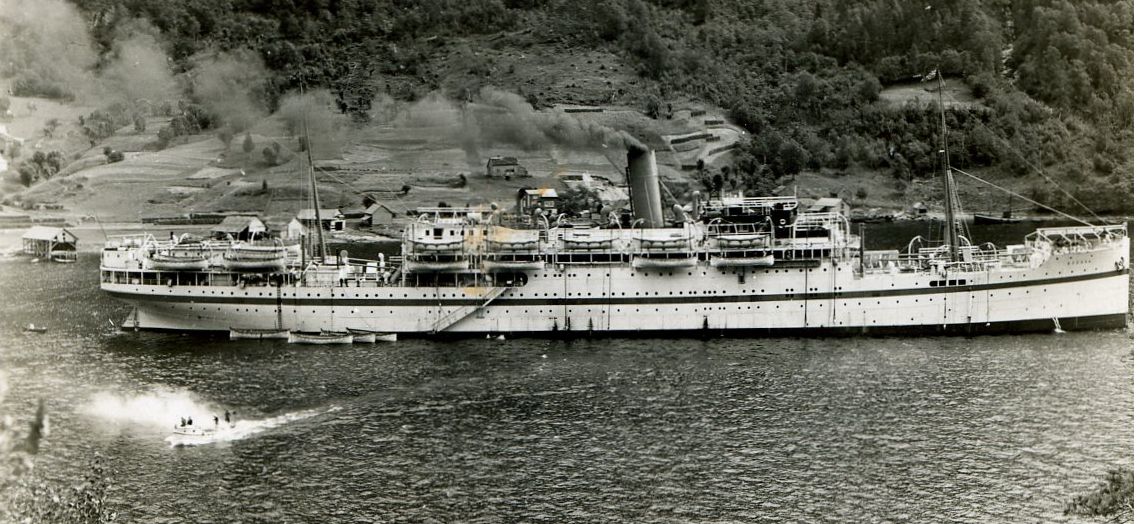
HMT Nevasa (Norway)
|
This photo of the first HMT Nevasa. My father was and Able
Seaman aboard her 1942-43. This photo was taken during her
trip to Norway when she dissembarked troops. Ironically I
sailed back with her to the UK December 1959 from Active Service
with the Army in Malaya.
Regards
John Dougherty
Royal Artillery.
|
|
|
|
I had found a tiny (6x4cm) photo in my father’s effects,
with the wording on the reverse - Ron Flood
“Convoy through porthole HMT Nevasa, Red Sea 1940”
|
New Australia

|
New Australia
Leaving Singapore for the UK 1954. The SS New Australia
rose from the charred remains of a burnt out wreck which had
been written off and destined for scrap. She became a migrant
ship, transporting thousands of British settlers and their
families to a new life in Australia and also, as a troopship,
played an important role in Australian military action in
the Korean and Malayan conflicts.
|
Neuralia
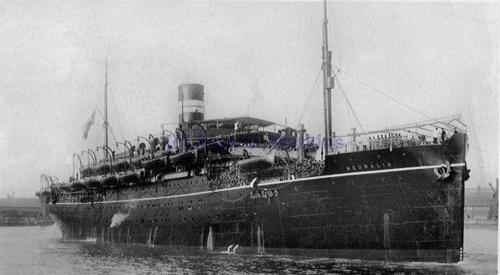
|
S.S./H.M.T. Neuralia
Built in 1912 in Glasgow as a passenger liner for the British
India Line. At the outbreak of World War I she was quickly
converted for service as a troopship, as the prefix H.M.T.
suggests. She undertook passenger duties and educational cruises
between the wars but returned to troopship duties in World
War II. She survived several U-boat attacks, but was finally
sunk by an Italian mine on May 1st, 1945 with the loss of
4 lives.
Taking 27,000 troops to the beaches
From the Bolton Evening News, first published Friday 4th Jun
2004. - ALLAN WOODHEAD was a Sergeant pharmacist of No 3 Coy,
Royal Army Medical Corp, the sea-going company, which provided
medical staff for hospital and troop ships. On June 2, 1944,
Mr Woodhead, from Quarlton Drive, Hawkshaw, joined HMT Neuralia
in King George V Dock in London
Neuralia embarked 1,800 troops and sailed on June 6. In
line ahead, the convoy rounded North Foreland into the Dover
Straits, with all troops below deck, and the ship at "Action
Stations". We had to pass the German guns on the French
coast in Pas de Calais. As it turned out they were strangely
silent. This was fortunate, as at 12 knots we would have been
in range for an hour or so. Later we found that the guns had
set on fire and sunk SS Sambut which had sailed earlier.
Neuralia was delayed in the Solent and travelled overnight
to disembark troops off Gold Beach by scrambling nets over
the side into landing craff. The ship then returned to the
Solent to embark for the next trip. This went on all summer,
mostly taking American troops to Omaha beach -- 27,000 troops
in all.
Archive Home
From the Bolton Evening News
http://www.boltoneveningnews.co.uk
© Newsquest Media Group 2004
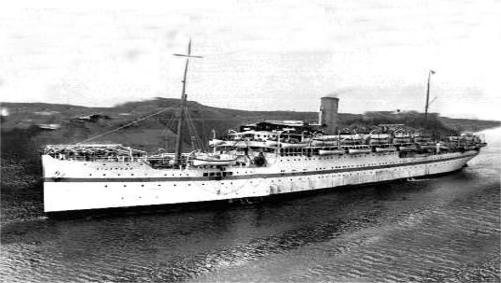
HMT Neuralia seen on Whangpoo River off Shanghai November
8th 1929 — Shanghai is not on the River Yangtsze as
is generally thought, but on its tributary, the Whangpoo.
1st Battalion Worcestershire Regiment (1922 to 1938)
Bombay to Shanghai and home again (1929 to 1931)
The 1st Battalion embarked in H.M.T. Neuralia at Bombay
on the 22nd of October, 1929, and all enjoyed the 17 days
voyage to Shanghai. There were few troops on board besides
the Battalion, and they had plenty of accomodatjon and deck
room.
|
Ormonde

|
SS.Ormonde
Orient Steam Navigation Company - 1917 14,982 tons - "Ormonde"
was built by Orient Lines in 1917 as a troopship. She served
the UK - Suez - Australia route between the wars. Converted
to one-class in 1933. Troop carrier in WWII. Returned to commercial
service in 1947, again on the Europe - Australia route. She
was scrapped in Dalmuir in 1952.
|
Orbita
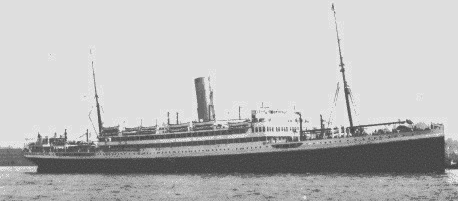
|
SS. Orbita
Built by Harland and Wolff at Belfast, launched Jul 7th
1914, 15495tons, sister ship to Orduna. Troopship from 1941
to being broken up in 1950 by Thos. W. Ward at Newport, Monmouthshire.
Chris Madden writes: As a small boy, my family travelled
to join my Army Father, from Liverpool to Singapore on HMT
ORBITA leaving UK in December 1949, and arriving in Singapore
in Jan 1950. The voyage took 6 weeks, with one of the four
engines u/s throughout, and one other working intermittently.
The ship was certaily on its last legs and I think was scrapped
soon afterward. It was not painted in normal HMT colours,
but retained the black hull, white superstructure, and yellow
funnel.
To confirm Chris Madden's observation - the RMS Orbita sailed
from Liverpool on 4th July 1950 conveying Royal Signals and
Guards service personnel to Singapore where the vessel arrived
on 8th September having stopped on the way at Port Said, Aden
and Colombo . Its final voyage was that of returning to the
UK in September 1950 - Geoffrey Garner [Ex Royal Signals}
.
|
Orontes

|
SS. Orontes (Orient Line)
Usually on Capetown run. approx 20,000tons - Operating
life: 1929 -1962
Tonnage: 19,970 - Passengers: 1,612 - Constructed: Vickers,
Barrow
The last of the five 20,000 tonne sisters, Orontes was distiguished
by her curved and more modern bow. She too served during the
war as a troop ship and was refitted by Thorneycroft in 1947
prior to resuming her commercial service.
|
Oxfordshire
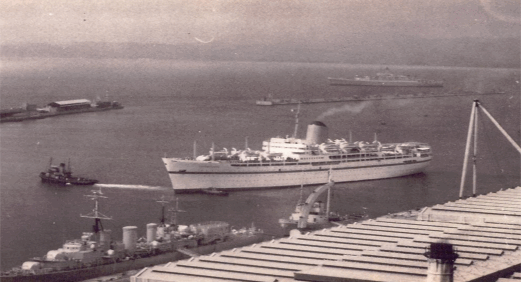
|
|
HMT. Oxfordshire
Leaving Gibraltar - built by Fairfield Govan,
Yard No 775
Engines by Fairfield SB&E Co Ltd Glasgow
--------------------------------------------------------------------------------
Last Name: RIPA, Previous Names: FAIRSTAR
Port of Registry: Liverpool
Propulsion: 4 Steam turbines geared to 2 sc shafts 18000shp
20 knots
Launched: Thursday, 15 December 1955, Built: 1957
Ship Type: Troopship, Ship's Role: Cruising latterly
Tonnage: 23180 grt, Length: 609 feet 5, Breadth: 78 feet 3,
Draught: 267 feet 7t
Owner History:
Bibby Line Liverpool.latterly SITMAR
Status: Scrapped - 10/04/1997 Alang India
|
|
|
HMT Oxfordshire
Operating life: 1957 - 1997 - Tonnage: 20,586 - Passengers:
500
Constructed: Fairfield, Glasgow
The Oxfordshire was built by the Bibby Line and the Ministry
of Transport as a troop carrier. In 1962 she was released
to the Bibby Line who sold her on to the Sitmar corporation
in 1964. Renamed the Fairstar, she commenced sailing between
the UK and Australia carrying 1,870 passengers in one class.
In 1973, she was stationed in Sydney and commenced a new life
cruising between the Antipodes, South Pacific and South-East
Asia. Nicknamed the "FunShip", she provided many
with memorable holidays in the tropical sun. She was refitted
and repainted following P&O's takeover of Sitmar cruises
and sailed for another eight years before escalating maintenance
costs took their toll and she was depatched to the breakers
in India.
|
Otranto
|
SS. Otranto
Tonnage: 20,032tons - Length: 200,6 m - Beam: 22,9 m - Speed:
20 kn - Operating life: 1929 - 1957 Orient Line. - Built:
1929 Vickers-Armstrongs, Barrow-in-Furness, England - Passengers:
1,686 - She was built for London - Brisbane line.
In 1939 she became a troopship for the Ministry of War Transport,
London.
In 1949 she resumed passenger service on the route London
- Sydney. In 1957 she was scrapped at Faslane, Scotland.
Otranto was one of five liners of 20,000 tonnes built to replace
tonnage lost during the first world war. She survived the
second conflict serving as a troop ship, although three of
her sister ships, Orama, Orford and Oronsay were lost.
|
|
SS. Otranto
|
Orduna
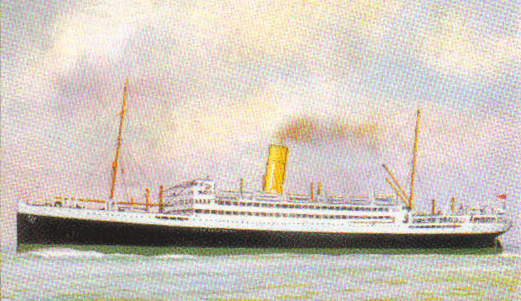
|
RMS. Orduna - (Leslie Youdell)
Built : 1914 :Harland & Wolff, Belfast
Tonnage : 15,507g, 1941 : Taken over as troopship 1946 : Government
trooping service. Boat deck derrick posts removed prior to
this. 1950 : Nov : Decommissioned and laid up
1951 : Broken up at Dalmuir after 37 years exemplary service
|

|
|
Another view of RMS Orduna - (Peter Smith)
Peter Smith writes: In 1949 my mother and I sailed to Sri
Lanka (Ceylon) to join my father who was in the RAF. I notice
that the photo in your gallery is not of a too high standard
and I attach one that may be of interest. The picture was
taken by my father, flying a Douglas DC3, of the RMS Orduna
when she was 150 miles out from Colombo. We returned to the
UK as a family arriving December 24th 1951 on the Empire Trooper.
|
Oronsay
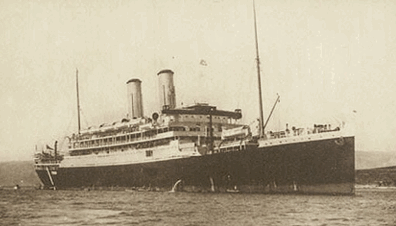
|
SS. Oronsay
20,000tons Torpedoed 9th October 1942 - This ship picked
up many survivors from Lancastria sinking and returned to
England.
|
Orion
|
SS. Orion at Gibraltar - RMS
ORION
Tonnage: 23,371 GRT (gross registered tonnes)
- Length: 665ft (202.7m) - Beam: 82ft (25.6m) -Draught: 30ft
(9.1m) - Engines: Six Parsons SRG Steam Turbines (24,100 SHP)
- Screws: Two - Service speed: 21 knots. - Passenger Decks:
Seven - Passengers: 708 Cabin Class, 700 Tourist Class. Later
1,691 One Class (Tourist) - Crew: 466, later 565 |
Osmanieh
|
|
OSMANIEH - 123890
Owner -Khedivial Mail S.S. & Graving Dock Company -
1906.
Date launched - Wednesday - 09th May, 1906.
Builder - Swan, Hunter & Wigham Richardson Yard 761.,
4,041 tons, 360-2x45-2x24-3. 650n.h.p, 17 knots. Quadruple-Expansion
Engines. The liner Osmanieh, Lieutenant Commander D. R. Mason,
was taken over for service as a fleet auxiliary during the
First World War. On Monday - 31st December, 1917, she was
carrying troops and medical staff to Alexandria when she struck
a mine laid by UC 34 under the command of Oberleutnant zue
See Horst Obermuller at the entrance to the harbour. She sank
very quickly taking with her: Lieutenant Commander D.R. Mason.
(Commemorated - Alexandria (Hadra) War Memorial Cemetery)
Two other officers. 21 of its crew. One military officer.
166 other ranks.Eight nurses.
|
Queen Elizabeth 2
|
|
RMS Queen Elizabeth 2
Gross Tonnage: 70,327 (originally 69,053) - Net Tonnage:
37,182 (originally 36,038)
Deadweight Tonnage: 11,649
Dimensions - Length: 963 ft (293.52m) - Breadth: 105 ft (32.07m)
Draft: 32 ft
Machinery
9 MAN B&W Diesel Engines - 10,625 kW at 400 rpm
2 propellers - 22 ft diameter, 42 tons - 2 bow thrusters -
1,000 hp, variable pitch
4 Brown Brothers stabilizers - 12 ft length, 70 sq ft area
each
Rudder - 75 tons
Capacity - Passengers: 1,900 - Crew: 1,015 - Total: 2,915
QE2 requisitioned for Falklands War as a troop tansport.
On 12 May 1982 she set sail for St Georgia with 3000 troops
aboard. QE2 arrived safely back in Southampton on 11 June
1982.
|
Queen Bermuda
|
QTEV. Queen of Bermuda - (Leslie W. Youdell)
Queen of Bermuda, completed in 1933, was slightly larger
at 22,575 gross tons and a foot longer at 580 feet than her
sister ship Monarch of Bermuda. Service speed for both ships
was 19 knots. She had capacity of 731 first and 31 second
class passengers.
|
RMS Queen Elizabeth
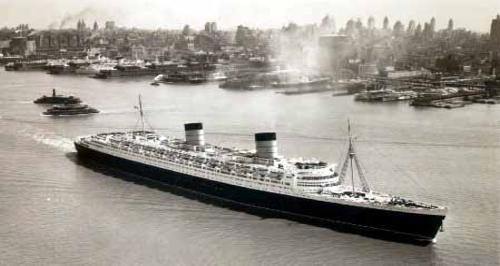
|
RMS Queen Elizabeth
Gross Tonnage - 83,673 tons - Dimensions -
300.94 x 36.14m (987.4 x 118.6ft)
Number of funnels - 2 - Number of masts - 2 - Construction -
Steel
Propulsion - Quadruple screw - Engines - Single reduction steam
turbines
Service speed - 29 knots - Builder - John Brown & Co Ltd,
Glasgow
Launch date - 27 September 1938
Passenger accommodation - 823 1st class, 662 cabin class, 798
tourist class
In 1942 the Admiralty drew up plans to convert
the two Queens into aircraft carriers but these were later abandoned
as it was considered that their troop carrying role was too
important. In April 1942 the Queen Elizabeth relocated from
Sydney to New York. Here the troop accommodation was altered
to make its capacity 10,000. In June 1942 it began to make voyages
from New York to Gourock and then to Suez, via Cape Town. In
August it began a shuttle service between New York and Gourock.
Despite the ever present threat of U-boats the ship continued
its service unscathed, although the German press stated that
a U-boat had hit the vessel with a torpedo on 11 November.
By the end of the war in Europe the Queens
had brought over a million troops to the war zone. The ship's
next duty was to repatriate these troops and redeploy troops
for the war against Japan. The repatriation of American troops
continued until October 1945 when the Queen Elizabeth was released
from US service and allocated to the repatriation of Canadian
troops. On 6 March 1946 it arrived back in Southampton and was
released from Government service as the need for troop movements
had diminished. During the war it had carried over 750,000 troops
and travelled 500,000 miles. |
Another view of: RMS Queen Elizabeth (Troopship)
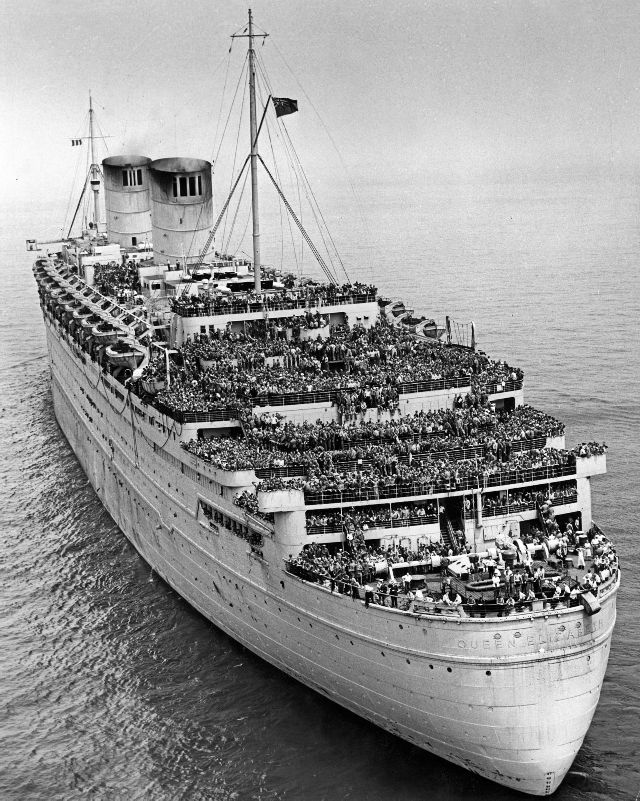
Encyclopædia Britannica, Inc.
|
Queen Mary
|
RMS Queen Mary
Cunard Line (then Cunard White Star Line) ocean liner that
sailed the North Atlantic Ocean from 1936 to 1967. Built by
John Brown and Company, Clydebank, Scotland, she was designed
to be the first of Cunard's planned two-ship weekly express
service from Southampton to New York, in answer to the mainland
European superliners of the late twenties and early thirties.
Queen Mary and her slightly larger and younger running mate
RMS Queen Elizabeth commenced this two-ship service after
their release from World War II troop transport duties and
continued it for two decades until Queen Mary's retirement
in 1967.
Tonnage: 81,237 gross tons
Displacement: 81,961 tonnes
Length: 1,019.4 ft (311 m) oa; 965 ft B.P.
Beam: 118.5ft (36.1 m)
Draft: 39 ft (12,00 m)
Height: 181 ft (55.17 m)
Main Engines: 160,000 shaft hp (119 MW) Parsons double reduction
steam turbines; max. 200,000 shaft hp (149 MW) steam turbines,
4 shafts
Speed: approximately 30 knots (56 km/h) - 29.5 knots (55 km/h)
cruising in service; maximum sustained speed was 32.6 knots
(60 km/h)
Passenger Capacity: 2139: 776 first (cabin) class, 784 tourist
class, 579 third class)
Crew: 1101
RMS Queen Mary together the Queen Elizabeth, were the largest
and fastest troopships involved in the war, often carrying
as many as 15,000 men in a single voyage, and often travelling
out of convoy and without escort. During this period, because
of their wartime grey camouflage livery and elusiveness, both
Queens received the nickname "The Grey Ghost". Because
of their size and prestige their sinking was such a high priority
for Germany that Adolf Hitler offered the equivalent of $250,000.00
and the Iron Cross to the U-boat commander who could sink
them. However, their high speed meant that it was virtually
impossible for U-Boats to catch them. Once, Germany was nearly
successful; whilst The Queen Mary was in South American waters,
a radio signal was intercepted which indicated that spies
had reported her last refuelling stop and a U-Boat was waiting
on her line of voyage. After being alerted, The Queen Mary
changed course and escaped.
On 2 October 1942 Queen Mary accidentally sank one of her
escorts, slicing through the light cruiser HMS Curacoa (D41),
with the loss of 338 lives.
In December 1942, the Queen Mary was carrying nearly 15,000
American troops from New York to Great Britain. While 700
miles from Scotland during a gale, she was suddenly hit broadside
by a rogue wave that may have reached a height of 28 meters
(92 feet).
|
Rajula

|
HMT. Rajula
Built 1926 - 1973 sold to Shipping Corporation of India,
renamed Rangat. 8,478tons
|
Rewa

|
HMT. Rewa
Built 1905 - 1918 torpedoed and sunk in Bristol Channel
while serving as hospital ship; loss of 3 lives.
|
Rohna
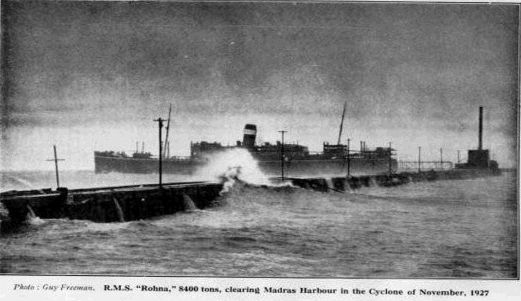
RMS. Rohna
8400tons, clearing Madras Harbour in the cyclone of November
1927

Another view (Dennis Martin) - My father sailed on her from
Southampton to China with 1 DLI in 1937.
|
|
RMS Rhona - The Sinking - 26th Nov. 1943
The ship was part of convoy KMF-26 (Annex) travelling east
from Oran to the Far East via the Suez Canal.
Of the 1,138 men lost, 1,015 were American. The attack still
constitutes the largest loss of U.S. troops at sea in a single
incident. A further 35 American troops of the 2,000 originally
on board later died of wounds. As well as the troops, five
ship officers and 117 ratings (out of 200) died, along with
11 of the 12 gunners on board and one hospital orderly.
The heavy loss was in part due to a flotilla of seven empty
large landing craft (LCI(L)) failing to stop to pick up survivors,
for which the commanding officer was relieved of his command.[citation
needed] However, 606 survivors were rescued by the minesweeper
USS Pioneer.
The details of the loss were revealed slowly over time and
were only released in full in 1967 following the introduction
of the Freedom of Information Act. However, already by February
1944 the US government had acknowledged that over 1000 soldiers
had been lost in the sinking of an unnamed troopship in European
waters, though it hinted at the time that a submarine was
responsible. By June 1945, the government had provided accurate
casualty figures, the ship had been identified by name as
Rohna, and the cause of the sinking had been identified as
German bombers. This account did not mention the fact that
a guided missile was responsible.
The sinking was done with a Henschel Hs 293 radio-controlled
glide bomb, launched and controlled by a Heinkel 177 bomber
piloted by Hans Dochtermann. HMT Rohna was not the first casualty
of a guided missile, however, as the British HMS Egret was
sunk on the Bay of Biscay with the loss of 198 men on 27 August
the same year by a Henschel Hs 293. Additional ships sunk
by Hs 293 missiles prior to Rohna include HMHS Newfoundland,
HMS LST-79, SS James W. Marshall, HMS Rockwood, HMS BYMS-72,
HMS Dulverton and MV Marsa.
A memorial to the sinking was unveiled at the Fort Mitchell
National Cemetery in Seale, Alabama in 1996.
|
Saga
|
SS. Saga
Built 1946 Gothenburg-London, 1956 sold to
French Line, renamed Ville de Bordeaux. 6,458tons |
Somersetshire

|
HMT SOMERSETSHIRE
HM Troopship Somersetshire was 7,456 gross
tonnes (Bibby Line). She was built in 1927 and converted into
a troopship with accommodation for 1,300 troops. In October
1927 the ship sailed to China and from January to May 1928 she
transported troops to Karachi and was laid up in Dartmouth..
During another voyage to China in 1931, influenza broke out
which affected 300 person but fortunately there were no deaths.
In September 1939, the Somersetshire was requisitioned and converted
into HM Hospital Ship No. 25 with 507 beds, 118 medical staff
and 171 crew members. She participated in the withdrawal from
Narvik in April 1940 and on 6 December 1940, was bombarded from
shore as her launches brought off the wounded at Tobruk. In
February 1941, the ship joined her sistership Dorsetshire in
evacuating the wounded from the besieged Tobruk, before operating
from the Red Sea to South Africa, Australia and New Zealand
repatriating wounded soldiers.
At 12.57 hours on 7 April 1942, German u-boat U-453 fired
a spread of four torpedoes at a steamer of 10,000 gross tonnes
and heard three detonations after 47 seconds. HMT Somersetshire
was not recognised as a hospital ship by the U-boat and fortunately
she was carrying no patients. She was hit was on the starboard
side, forward, and settled by the head with a list. One crew
member and six Royal Army Medical Corps staff were lost. 114
crew members, 64 medical staff members and two stewardesses
abandoned ship in 13 lifeboats. The crew later reboarded her
and managed to reach Alexandria on the port engine and assisted
by tugs. The remaining survivors were picked up by a Greek destroyer.
From 1944 to 1946, the Somersetshire sailed all over the world
as a hospital ship and finishing up in the Pacific. In February
1948, the ship was decommissioned and rebuilt by Harland &
Wolff to a passenger ship with accommodation for 550 passengers.
In 1953, the ship briefly returned to trooping to East Africa
during the Mau Mau troubles and in 1954 was broken up by Thos.
W. Ward in Barrow-in-Furness.
Before and during the 1939-45 War the movement
of troops between England and overseas garrisons was by sea.
In 1962 it was decided that overseas trooping would be carried
out by air, and the day of the troopship came to an end. Before
the War the best known troopships in regular service were the
British India Steam Navigations Company’s Dilwara, Dunera,
Neuralia and Nevasa and the Bibby Line’s Devonshire, Dorsetshire,
Lancashire and Somersetshire. They were all ships of rather
more than 9,000 tons gross with a service speed of 15 knots,
designed to carry a complete battalion and a number of drafts
and individuals. In the main the military staff on board were
RAF.
|
Tairea
|
SS. Tairea
Built 1924 - in 1952 scrapped UK. 7,934tons
|
Talamba
|
SS. Talamba
Shown here as a Hospital Ship - bombed and sunk off Sicily
while operating as hospital ship; loss of 5 lives. 8,018 tons
Built: 1924 by R&W Hawthorn, Leslie & Co., Ltd.
Hebburn.
Tonnage: 8,018 g, 3,844 nt, 8,100 dwt.
Engines: Twin screw, 2 x Triple expansion four cylinder,,
8,000 IHP, 16.5 knots by Builder.
Passengers: 56 1st Class, 72 2nd Class, 2,777 Deck and Crew
of 175.
Launched 16th July 1924, completed 2nd October 1924, Yard
No. 533.
Talamba is a town near Multan in the Punjab, now Pakistan.
|
Taliwa
|
SS. Taliwa
Built 1924 - in 1945 stranded and burnt out Nicobar Islands.
7,936 tons
|
Talma
|
|
SS. Talma
Built 1923 - in 1949 scrapped in UK. 10,000 tons
|
Transylvania
|
SS. TRANSYLVANIA
--------------------------------------------------------------------------------
built by Scotts Greenock,
Yard No 451 - Port of Registry: Glasgow
Propulsion: steam, turbines, 17.5 knots
Launched: Saturday, 23 May 1914
Built: 1914
Ship Type: Passenger Vessel
Tonnage: 14348 grt
Length: 548.3 feet
Breadth: 66.6 feet
Draught: 42 feet
Owner History:
Anchor Line
Status: Torpedoed & Sunk - 04/05/1917 - Remarks: Commissioned
as a troopship in May 1915 with accommodation for 200 officers
and 2860 men. On 04/05/1917 torpedoed off Cape Noli (40 miles
from Genoa) sank with heavy loss of life.
Photo supplied by The Book of the Anchor Line 1931
|
Vienna
|
SS. Vienna
Built 1929 in 1941 purchased from London & North Eastern
Railway, troop and hospital ship, 1945 Harwich-Hook of Holland,
1960 scrapped. 4,227tons
|
Empire Windrush

|
|
HMT. Empire Windrush
14651tons, 1930 Passenger Ship.
1930 MONTE ROSA, Hamburg South America Line.
1940 German Navy barracks and troopship.
1945 Seized by Allies at Kiel.
1946 EMPIRE WINDRUSH, MOT managed by New Zealand Shipping
Co.
30.3.54 Sank off Algeria in tow after engine room explosion.
|
|
Another view of MV Windrush in Hong Kong harbour ( David
Armstrong ex - Royal Signals Ist Commonwealth Div Korea)
|
|
HMT Empire Windrush - on fire off the coast of Algeria,
March 1954.
|
Warwick Castle

|
|
Warwick Castle - Type: Troop transport
Tonnage 20,107 tons - Completed 1930 - Harland & Wolff
Ltd, Belfast
Owner Union-Castle Mail SS Co Ltd, London - Homeport London
Date of attack 14 Nov 1942 Nationality: British
Fate Sunk by U-413 (Gustav Poel) - Position 39° 12'N,
13° 25'W - Grid CG 4546
Complement 462 (96 dead and 366 survivors).
Convoy MKF-1X - Route Gibraltar (11 Nov) - Glasgow - Cargo
Ballast
History Completed in January 1931 as motor passenger ship
for Union-Castle Mail SS Co Ltd, London. In Sepember 1939
requistioned by the Admiralty as troopship.
Notes on event At 08.44 hours on 14 Nov 1942 the Warwick Castle
(Master Henry Richard Leepman-Shaw) in convoy MKF-1X was hit
by one of two torpedoes from U-413about 200 miles northwest
of Cape Espichel, Portugal. The U-boat hit her with two coups
de grâce at 08.57 hours, that caused the ship to sink
about one hour later. The master, 61 crew members and 34 service
personnel were lost. 201 crew members, 29 gunners, 5 naval
personnel and 131 service personnel were picked up by HMS
Achates (H 12) (LtCdr A.H.T. Johns, DSO, RN), HMS Vansittart
(D 64) (LtCdr T. Johnston, DSC, RN), HMCS Louisburg (K 143)(LtCdr
W.F. Campbell, RCNVR) and the British motor merchant Leinster
and landed at Greenock.
The Warwick Castle had been in convoy
KMF-1 for Operation Torch and landed her troops on 10 November
|
Windsor Castle
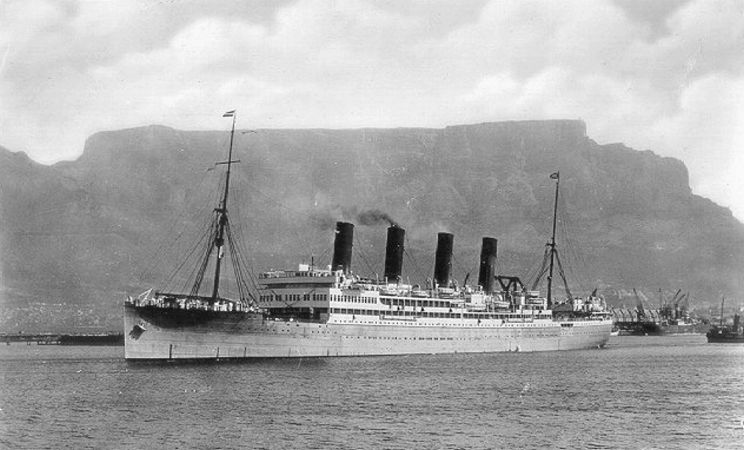
Windsor Castle - leaving Cape Town

Windsor Castle arriving at Southampton
|
|
Windsor Castle (1937) after removal of 2 Funnels
|
|
The Windsor Castle - Specifications:
Length: Originally 661 feet (201.9 m), 686 feet (209.6 m)
after 1937 refit.
Beam: 72.5 feet (22.2 m)
Tonnage: Originally 18,967 gross tons, 19,141 after 1937 refit.
Engines: Steam turbines turning two propellers.
Service speed: Originally 17 knots, 20 knots after 1937 refit.
Passengers: 870 people, reduced to 604 during 1937 refit.
When the Second World War erupted in September 1939, she
was requisitioned for use as a troop transport. For this purpose,
she was painted entirely grey, and many of the windows in
her superstructure were covered.
On November 4th 1940, Windsor Castle was attacked by German
aircraft while travelling in the waters west of Ireland. During
the attack, a 500-pound bomb dropped from one of the German
planes landed in the first class smoking room. Fortunately,
the device failed to explode. Had it done so, the devastation
would most certainly been horrific. Surviving this extremely
close shave, Windsor Castle could continue on her way. The
bomb was removed when the ship docked at Greenock the following
day.
Having survived such an incident, it was perhaps thought that
Windsor Castle was a ship with great fortune. Sadly, this
was not the case. Three years later, on March 23rd 1943, Windsor
Castle was sailing in a convoy that had left Greenock a few
days earlier and was now in the Mediterranean Sea, about 110
miles Northwest of Algiers. Early that morning, the convoy
was attacked by German bombers. A torpedo launched from one
of the aircrafts hit the Windsor Castle, which began to sink
by the stern.
With 290 crew and 2,699 troops on board, the death toll might
have been devastating. Fortunately, the Windsor Castle managed
to stay afloat for thirteen hours after the attack, thus making
it possible for other vessels to come to the rescue. In the
end, all people on board were rescued, except for one crewman
who had been killed. With the rescue ships still gathered
around her, the Windsor Castle finally sank, stern first.
Her captain gave her final position as 37° 27' N –
00° 54' E. There she remains to this day, unexplored as
far as I know.
|
Winchester Castle
|
Winchester Castle
Built: 1930 by Harland & Wolff, Belfast.
Tonnage: 20, 109g, 12, 228n.
Engines: Twin Screw, 4 Stroke Double Acting B & W Type,
2 x 8 Cylinder, 3, 360 NHP, 20 Knots.
Passengers: 260 First Class, 243 Second Class, 254 Third Class,
350 Crew.
Launched 19th November 1929, completed 11th October 1930.
Her maiden voyage was made on the 24th of October. In 1936
she stranded near Portland and Armadale Castle was brought
out of reserve to replace her. She underwent modernisation
at the yard of her builders and was fitted with Burmeister
and Wain diesels producing 26, 000 BHP which increased her
service speed by three knots reducing the passage time by
two and two-third days. In 1941 she made one trooping voyage
to Bombay and after became the Headquarters ship for Montbattens
Combined Operations after which she spent a year in Scottish
Waters training men for Seaborne Assault Landings. She was
the Headquarters ship for the Allied Landings of the Vichy
controlled Island of Madagascar and was accompanied by Keren,
Karanja, Llandaff Castle, Sobieski which were escorted by
the Battleship Ramilles. After the successful landings the
Merchant ships sailed round the coast to Diego Suarez where
Winchester Castle code-named Radio Diego Suarez for the exercise
made propaganda broadcasts. For the action she ship's Master,
Captain S.F. Newdigate was awarded the Distinguished Service
Cross. On the 22nd of July during a trooping voyage from the
U.S.A. to the U.K. she picked up 39 survivors from the U.S.
Freighter Honolulan which had been torpedoed by U-582. She
took part in the North African Landings at Sidi Ferruch, Algiers
code-named Operation Torch on the 6th November. September
of the following year she saw action at the Salerno Landings
code-named Avalanche in which Lt. General McCreery's 56th
Division, British X Corps were landed between Paestum and
Maiori either side of Salerno. On the 15th of August 1944
she took part in Operation Dragoon landing troops near Cannes
for the Allied invasion of Southern France. 1947 - 1948 found
her on the emigrant service with berths for up to 877 passengers
after which she returned to Harland & Wolff for a major
overhaul. On the 22nd of September 1948 she once more entered
onto the mail run with passenger compliments of 188 First
Class and 400 Tourist. She was sold for scrapping in 1960
being replaced by Windsor Castle, and arrived at the yard
of Nichimen K.K., Mihara, Japan on the 5th of November.
Warwick Castle was delivered in January of 1931 and in May
Lord Kylsant was issued a summons in connection with the prospectus
issued to launch Royal Mail's debenture stock, he subsequently
resigned from the Board and Walter Runciman replaced him.
He left to become President of the Board of Trade, also this
year Britain went off the Gold Standard and a National Government
was formed.
|

MV Worcestershire
|
Length 502ft ----Tons capacity 15,000 --- Gross Tonnage
11,452 --- Horsepower 10,000
The Worcestershire sailed on her maiden voyage from Liverpool
to Rangoon in March 1931.
An armed merchant cruiser, later a troop ship, during WW2,
she was back on the Burma run in 1949.
She had had a thorough refit, which included the removal of
several masts and a more modern, broader funnel.
After 30 years of service she was sold to breakers in 1961.
-------------------------------------------------------------------------------------------------------------------
On 31st Aug 1947, the Worcestershire sailed from Rangoon
carrying 14767987 Cpl Harry Austin (East Yorkshire Regt) to
UK for his class A discharge.
|
Zara
|
|
SS ZARIA
When the British garrison was withdrawn from Bermuda, the
4th Battalion Worcestershire Regiment was commanded by Lieut.-Colonel
C. M. Edwards.
On the 13th November 1905 they were transported by the steam
ship s.s. Zaria and carried back across the Atlantic and down
the Straits to Malta arriving there on the 2nd December 1905.
|
g
Empire Ships
Empire Ace - Empire Admiral - Empire Aid -
Empire Baltic - Empire Battleaxe -Empire Cavalier - Empire
Cedric - Empire Celtic (2) - Empire Celtic - Empire Chub -
Empire Clyde (2).
Empire Clyde - Empire Curlew - Empire Deben
- Empire Doric - Empire Fitzroy - Empire Fowey (2) - - Empire
Fowey (3) - Empire Fowey - Empire Fred - Empire Fulmar - Empire
Gaelic L3507 - Empire Gaelic - Empire Grebe - Empire Guillemot
(2) - Empire Guillemot - Empire Gull L3513
Empire Gull - Empire Halladale - Empire Ken (2) - Empire Ken
- Empire Kittewake -
Empire Netta - Empire Nordic - Empire Orwell
(2) Empire Orwell - Empire Parkeston (2) - Empire Parkeston
- Empire Petrel - Empire Plane - Empire Pride (2) - Empire
Pride -
Empire Roach - Empire Rosa - Empire Shearwater
- Empire Star - Empire Taw - Empire Teak
Empire Tern - Empire Test
Empire Ship Name Changes (Martin Young)
Name changes of the "Empire" troopships might
be of interest. The "Empire" name is in capitals,
with earlier names in lower case in front of that name, and
subsequent names in lower case after that name.
Letitia BRENT Captain
Cook |
Elizabethville BURE
Charlton Star |
Cameronia CLYDE |
| York Castle COMFORT |
Thuringia General San Martin DEBEN
|
Potsdam Empire Jewel FOWEY Safina-E-Hujjaj |
Antonoi Delfino Sierra Nevada HALLADALE |
Ubena KEN |
Maiden Castle LIFEGUARD |
Dimboola Hong Siang LONGFORD |
Eastern Prince MEDWAY |
Pretoria Empire Doon ORWELL Gunung
Djati Tanjung Panda |
Prince Henry North Star PARKESTON |
nPRIDE Charlton Pride Embassy |
Scarborough Castle PEACEMAKER |
Rayleigh Castle REST |
Barnard Castle SHELTER |
Thysville TEST |
Cap Norte Sierra Salvada TROOPER |
Linz WANSBECK Esperos |
Milwaukee WAVENEY |
| Patria WELLAND Rossia |
Monte Rosa WINDRUSH |
Princesa Victoria, DUNNOTTAR CASTLE,
Victoria - The Victoria |
|
|