August 1944"Liberation of Honfleur"
Foreword by WebmasterJim Corbett landed in Normandy as part of the 6th Airborne Division and he tells of his experiences as his unit entered Hornfleur and his links with that town now. After his service in Europe he was shipped to India for training to fight the Japanese but luckily the war ended and Jim finished his service in Kowloon before being demobbed.Jim then joined the Police Force and served 30 years before retiring in 1976, but not content to sit back he entered local Goverment enforcing planning laws. He feels he's done his bit - 5 years fighting for his country - 30 years Police Service - and 11 years serving the local community.Jim lives in the West Country of England and enjoys retirement with his wife, three children and five grandchildren.Now read Jim's memories and his return to Hornfleur.
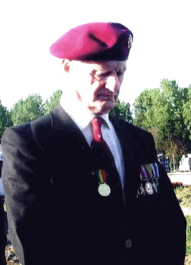
Each year, as the end of August approaches, I return to Honfleur in Normandy.My annual pilgrimage serves two distinct purposes; to join with the town's citizens in celebration of their liberation, and to honour the memory of four comrades who lost their lives bringing it about. This year was special. It was the 60th anniversary and probably my last visit. My own advancing years and my wife's increasing ill-health combine to make it unlikely that the trip will be repeated. In addition - to my great pleasure - nineteen members of my extended family were making the trip to participate in the celebrations.
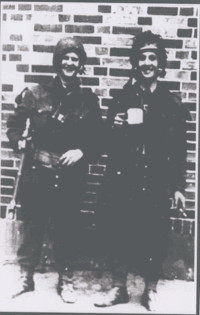
Jim Corbett & Frank DouganAs I stood on the dais in the Town Hall, waiting my turn to speak, my thoughts inevitably returned to that momentous day in 1944. The 6th Airborne Division had broken out from the bridgehead where they had been holding the east flank of the Invasion Force since D-Day, and were advancing on a broad front towards the Seine. With great difficultly, (because all the bridges had been blown) we crossed the river at a small town called Touques. We had been marching, in full kit, since dawn and were hoping for a rest and a brew-up - but fate decreed otherwise. Somewhere, back at HQ, a senior officer had ordered a small fighting force to race through the enemy lines in an effort to reach Honfleur. The objective was to prevent the enemy from destroying the port installations: obviously, of inestimable value in supplying the Allied advance through France and beyond. For a reason we should never discover, they chose us - 19th Platoon of the 12th Devon's, 6th Air Landing Brigade! Of course, being Airborne Troops, we were without transport,
so we commandeered the local Fire Engine, together with a Citroen Baker's
lorry (painted white to distinguish it from military vehicles). I remember
the best seats were on the Fire After some minor skirmishes and an attack in a wood, we eventually reached a hill overlooking Honfleur at 1700hours. Even though it appeared that, elsewhere, the enemy was in full retreat, we were all pretty sure that, because of the Port equipment, Honfleur would be heavily defended. We were only 24 men and lightly armed. As I took my accustomed place in the front of No: 1 Section, I became acutely aware that the 6th Airborne Division and, in fact, the whole British Army, was some 20km. behind us, and not of immediate assistance. The Famous White Truck, Touques 1944At the "O" group meeting at the top of the hill, the Platoon Officer gave his orders, I well remember his words. "We shall just have to walk down this hill and see if they are going to defend the town. No 1 Section will lead as usual and keep well spaced out". At face value, I suppose it was a reasonable proposition - in fact, as far as I was concerned, the only thing wrong with it was the likelihood of it being me who would be the first to find out if Honfleur was defended! I looked down the hill with its narrow streets and houses on either side. It was deathly quiet! While they were letting the civilian vehicles return to Touques, I remonstrated quietly with Wally Edgar, the Platoon Sergeant, " Perhaps we should wait for some tanks to come up." I suggested. But Wally replied, "Jim , you have the honour of leading the whole Division into Honfleur, and if you live long enough to tell the tale, one day you may be really proud of this moment." As I recall at the time, I felt that this was not exactly reassuring, but it turned out tobe prophetically accurate. Avoiding the grass verges (German skull and cross-bones signs indicating they were mined), I led off down the hill. Scanning the houses each side, I searched for signs of machine guns which would have easily cut us to pieces before we could hit the ground; but there was no sign of life. As we got further down the hill, a few shops came into view and I began to hope that Honfleur was completely abandoned. Then as we approached a crossroads, I suddenly caught sight of two little faces at the bottom of a stone wall. I used the telescopic sight on my sniper's rifle and confirmed they were children. They disappeared, to be replaced by two adults undeniably French. Relieved, and not realising that I must have appeared a frightening sight, I stood up in order for them to see my British Airborne uniform. With my dirty, unshaven face, crossed bandoleers on my chest and two grenades hanging from my smock lapels, I'm sure I was not a pretty sight! Quickly to reassure them, I shouted, "Anglais,.. Anglais", and they all came out from behind the wall, laughing and crying as they ran towards us and embraced. When I had caught my breath, I asked them, "Where is the Boche". They pointed vaguely East , in the direction of Le Havre. Unfortunately, this was not so! They were, and later to our cost, assembling in the Station and St Leonard's Cemetery on the far edge of town. As more citizens appeared, there was a lot of back-slapping and kissing, and we were carried down the hill in an emotional crescendo of noise that I shall never forget. We reached the bottom and turned under an archway into the harbour frontage. Here, I received my first glimpse of this beautiful town. The sun was beginning to drop towards the horizon, and the port was filled with small boats, bobbing on the incoming tide. On thebroad quayside, many shop-keepers were still displaying their wares in a scene that was both peaceful and picturesque. |